
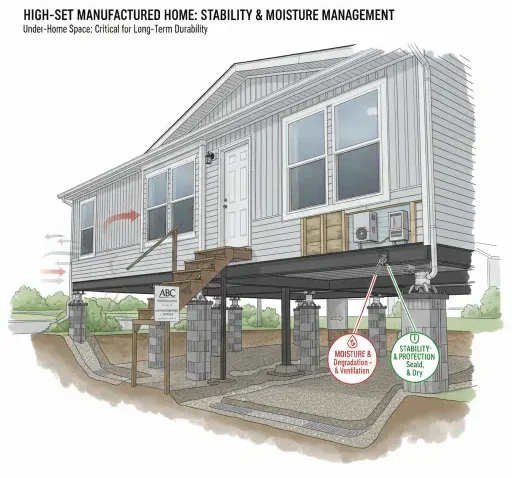
Your site needs the home higher than “normal” because the grade has to meet flood or drainage realities. That doesn’t automatically mean a problem—but it does change the under-home environment and the way stability and moisture have to be managed. This guide breaks down what to pay attention to (and what to ask your installer) so your high set doesn’t become a long-term headache.
High Pier Set Manufactured Home Considerations
If you’re planning an elevated install, think of this as a planning document you can use before the scope is finalized. A high pier set can work well, but it’s less forgiving when details are vague—especially around anchoring, under-home airflow, and moisture control, so its time to think about high pier set manufactured home considerations.
Why a “high set” changes more than the view from the porch
A higher set changes what’s happening under the home. That under-home space is where stability and moisture tend to either stay under control—or quietly turn into ongoing maintenance.
When a manufactured home sits higher because of flood-related grading, you’re usually dealing with a different mix of exposure:
- More moving air under the home (sometimes helpful, sometimes not)
- More visible under-home surfaces, including the ground and support system
- Different water behavior around the home depending on drainage and grading
- More wind exposure, which can change how the home “feels”
- More reliance on a clearly defined stabilization plan (not just “we’ll anchor it”)
One thing homeowners often miss is that stability and moisture are connected. If moisture is managed poorly, materials can degrade and the under-home environment can change. If stabilization is under-scoped, the home may feel less solid, which often leads to reactive “fixes” later that are more expensive than planning it correctly up front.
The high-set planning checklist (use this before your install is finalized)
Use this checklist as a scope-alignment tool. You’re not trying to engineer the home yourself—you’re trying to make sure the installer’s quote and plan match your site reality.
Site water flow and drainage assumptions
- What is the installer assuming about how water moves across the site during heavy rain?
- Is the plan based on “ideal drainage,” or does it account for your actual grading and runoff paths?
- Are there any site conditions that could change the scope once work begins (soft ground, uneven grade, standing water areas)?
Pier height assumptions and support layout clarity
- What pier height range is the plan assuming?
- Is the support layout described clearly enough that you can understand what’s being built (even in plain language)?
- What would cause pier height or support layout to change after the job starts?
Anchoring and tie-down expectations (and what could change them)
- Is anchoring included as a defined scope item, or mentioned loosely as “included”?
- What site or home factors could change anchoring scope once the home is set?
- Who is responsible for confirming the anchoring approach matches the site conditions?
Bracing and under-home access considerations
- Will the under-home area be accessible for future service and inspection?
- If additional bracing is needed for a taller set, how will that be handled and documented?
- Where will access points be located so maintenance isn’t a crawl-through-everything situation? (TBD specifics)
Moisture strategy (ground vapor, airflow, and skirting approach)
- What’s the plan for ground moisture—what will prevent moisture from rising into the under-home space?
- What’s the plan for airflow—how will the under-home area avoid becoming damp or stagnant?
- If skirting is planned, how will it be designed so it doesn’t trap moisture?
Documentation and inspection readiness (what to get in writing)
- What assumptions and exclusions are stated in writing?
- What triggers a scope change or add-on, and how is that communicated?
- If there are transaction or inspection requirements, what documentation is expected, and who provides it? (No guarantees—requirements vary.)
If you want this checklist to work in real life, send it to your installer and ask them to answer it point by point. Clear written assumptions now are the easiest way to avoid confusion later.
Stability and “feel”: why taller pier sets can feel different
Homeowners often describe stability in simple terms: does the home feel solid when you walk across it? Does it feel “bouncy” in certain areas? Does it feel different when the weather is windy?
A taller pier set can feel different for a few reasons:
- The home may have more exposure to wind, which can create a different sensation inside.
- The support and stabilization system has more “job” to do because the set is taller and less shielded.
- Small scope gaps become more noticeable. On a low set, you might never feel the difference. On a higher set, you might.
This is where it helps to replace vague comfort statements with a clear plan. You’re not trying to eliminate all movement—homes can move slightly without being unsafe. You’re trying to avoid the kind of movement that makes you worry, leads to repeated adjustments, or suggests the stabilization plan wasn’t matched to the site.
Here’s the misconception that causes trouble: a high set isn’t automatically unsafe. But it is often less forgiving of sloppy scope. If the plan is vague—“anchors included,” “skirting included,” “setup included”—the result can be a home that feels fine at first and becomes a maintenance project later.
Does higher pier height need more anchors? How to think about it safely
This is one of the most common questions homeowners ask: does being higher mean you need more anchors?
The safest way to think about it is this: anchoring is part of an overall stabilization system. It isn’t a single add-on that magically solves everything. On a higher set, the installer may need to account for different exposure and site conditions, and that can affect the anchoring plan.
Instead of asking, “Do I need more anchors?” ask questions that force clarity about the assumptions behind the plan.
Questions to ask without pretending to be an engineer
- “What anchoring approach are you assuming for this site and this set height?”
- “What conditions would cause the anchoring scope to change once you see the site and home in place?”
- “Is anchoring included as a defined scope item with assumptions, or is it a placeholder?”
- “If the site conditions differ from the assumption (soft ground, slope, drainage), what happens to the plan and the quote?”
The common failure mode: “anchors included” with no stated assumptions
When a quote says “anchors included” without describing assumptions, you’re exposed to two risks:
- You may be comparing quotes that aren’t including the same anchoring scope.
- You may be accepting a plan that changes later, when time pressure is highest.
The fix is simple and reasonable: get anchoring scope described in plain language in writing, along with what would trigger changes. Even if the details have to be finalized after site evaluation, you want the decision logic documented.
Moisture under a high set: what changes and what homeowners can control
Moisture is where high sets can surprise people. Some homeowners assume higher automatically means “drier” because there’s more air under the home. Others assume it means “wetter” because the site is flood-related.
The reality is that high sets can get wetter or drier depending on your site and how the under-home space is managed.
Ground moisture vs airflow vs vapor barriers (plain-English definitions)
- Ground moisture is moisture that comes up from the soil and increases humidity under the home.
- Airflow is the movement of air under the home, which can help remove moisture—unless it brings moisture in or creates uneven conditions.
- A vapor barrier (often a ground vapor layer) is a material placed to reduce moisture rising from the soil into the under-home space.
You don’t have to master building science to make good decisions here. You just need a basic strategy that addresses all three, not just one.
What changes with a high set
With more under-home space, you often have:
- More opportunity for airflow, which can help—if managed
- More surface area and visibility, which can reveal problems sooner
- More reliance on details like ground coverage and enclosure design, because “leave it open” vs “skirt it” becomes a real decision with tradeoffs
The common failure mode: sealing everything tight and trapping moisture
A high set often leads homeowners to want skirting for appearance and to block animals and debris. That makes sense. But if skirting is treated as purely cosmetic and is sealed without a moisture strategy, the under-home space can become a moisture box.
A safer mindset is: skirting changes the under-home environment. Once it’s enclosed, the moisture strategy matters more, not less.
If you’re unsure, ask your installer how they plan for ground moisture and airflow before the skirting decision is finalized.
Skirting on high sets: how to keep it dry and avoid creating a moisture box
Skirting is one of those topics where homeowners get confident too quickly because it looks simple: you enclose the perimeter, it looks finished, you’re done.
On a high set, skirting can do good things:
- Make the home look complete
- Reduce debris and animal intrusion
- Help control wind under the home in some cases
But skirting can also create problems if it traps moisture or prevents practical access for maintenance.
What skirting is supposed to do (and what it can accidentally do)
Skirting is supposed to create a boundary. What it can accidentally do is change airflow and humidity patterns under the home in a way that holds moisture in place.
If you think of skirting as an enclosure, a few questions naturally follow:
- How will air move under the home once it’s enclosed?
- What is the plan for ground moisture management inside that enclosure?
- How will you access the under-home area for inspection and maintenance?
Venting and access: function beats “perfectly sealed”
Without getting into technical thresholds, the practical point is that a skirting plan should balance:
- Moisture control
- Airflow behavior
- Access for maintenance
Access panels matter. If you can’t get under the home without taking things apart, small issues become big ones because people avoid checking them.
If your installer has a preferred approach for vents and access panels, ask them to explain it in plain language and document it. If they don’t, consider that a sign you should slow down and plan it more carefully. (TBD specifics depend on the site and skirting type.)
“Looks finished” vs “functions well”
A high set often invites a strong desire to make the home look “grounded.” That’s understandable. But if you have to choose between a perfectly uniform appearance and a skirting approach that stays dry and serviceable, function should win.
You can improve appearance over time. Moisture problems tend to get worse if they’re baked into the enclosure design.
Inspection and transaction concerns: what to clarify early (without guarantees)
When elevation is tied to flood grading, homeowners sometimes assume inspections will be more difficult. Sometimes they are. Sometimes they aren’t. It depends on what the inspection or transaction requirement actually is.
Requirements can vary because different stakeholders ask for different things:
- A lender may have condition language tied to foundation or stability documentation
- An inspector may focus on specific items based on the transaction type
- A buyer/seller timeline may create pressure to “just get it done,” which is where vague scopes cause trouble
The best way to reduce risk is not to chase generic rules. It’s to clarify what your specific transaction or inspection requires and align the scope accordingly.
What to get in writing
- A description of the scope assumptions: site, set height, stabilization approach
- Exclusions: what isn’t included so you can plan for it
- Triggers for changes: what conditions create add-ons and how they’re approved
If you’re dealing with lender language or a specific document request, don’t let anyone guess what document is needed. Ask for clarity, then align the work and documentation to that requirement. No one can promise approval outcomes, but you can avoid the preventable mistake of producing the wrong scope or the wrong paperwork.
When to request a site evaluation vs guessing
If the set is high because the site is complex, it’s often worth asking for a more grounded evaluation rather than accepting a generic answer like “we do high sets all the time.”
A site evaluation can help clarify:
- Access and staging assumptions
- Water and drainage realities
- How the stabilization and moisture strategy should be approached
Even if the evaluation doesn’t eliminate all uncertainty, it replaces guesswork with a clearer decision.
Next steps: align your installer, your site plan, and your long-term maintenance
A high pier set isn’t just an installation choice—it’s a long-term maintenance environment. If you plan it well, it can be stable, dry, and serviceable. If you plan it vaguely, it can turn into repeated adjustments and moisture management problems.
Here’s a practical decision logic:
- If your installer can clearly explain assumptions, exclusions, and triggers in writing, you’re in a safer position.
- If the plan is vague and relies on “we’ll see,” you’re likely to face surprise scope changes later—when your timeline is tight.
- If you’re being asked to finalize skirting without a moisture and access strategy, slow down and align those decisions first.
If your home has to sit higher because of grading or flood-related elevation, don’t rely on generic advice.
Send us your site photos, the elevation constraint, and your home basics (single vs multi-section).
We’ll help you map what changes—stability, anchoring scope, moisture control, and skirting—so your install plan fits the site.
Call or request a quote review—scope-first, no pressure.
FAQ
What are the biggest high pier set manufactured home considerations?
The biggest considerations are usually stability planning, anchoring scope clarity, moisture control under the home, and a skirting approach that balances airflow and access. With a higher set, details and assumptions matter more because the under-home space is more exposed and less forgiving of vague scope.
What problems can happen with a manufactured home set too high?
Common concerns include the home feeling less solid if stabilization is under-scoped, moisture issues if the under-home environment is enclosed without a moisture strategy, and maintenance headaches if access under the home is difficult. A high set can work well, but it benefits from clear planning rather than generic “it’ll be fine” answers.
Does high pier height need more anchors? What should I ask my installer?
Anchoring needs can depend on site conditions, home configuration, and the overall stabilization plan. Ask your installer to state the anchoring assumptions in writing, explain what would trigger changes to the anchoring scope, and clarify whether “anchors included” means a defined scope item or a placeholder pending site evaluation.
Do I need a moisture barrier under a high set manufactured home?
A ground vapor layer is commonly used to reduce moisture rising from the soil, but the best choice depends on the site and the overall moisture strategy (ground moisture, airflow, and whether skirting will enclose the space). Ask your installer how they plan to manage ground moisture and airflow together, not as separate afterthoughts.
How do you keep skirting dry on a high set manufactured home?
Start by treating skirting as an enclosure that changes the under-home environment. A good plan typically accounts for moisture control from the ground, airflow behavior, and practical access panels for maintenance. If skirting is sealed without a moisture strategy, it can trap moisture and create ongoing dampness.
What inspection concerns come up with high pier manufactured homes?
Inspection and transaction concerns often relate to whether the scope and documentation match the specific requirement being asked for (which can vary by lender, inspector, or transaction). The safest approach is to get scope assumptions and exclusions in writing and avoid guessing about documentation requirements.
If your home has to sit higher because of grading or flood-related elevation, don’t rely on generic advice.
Send us your site photos, the elevation constraint, and your home basics (single vs multi-section).
We’ll help you map what changes—stability, anchoring scope, moisture control, and skirting—so your install plan fits the site.
Call or request a quote review—scope-first, no pressure.
RELATED LINKS: