
If you’re deciding between a manufactured home (“mobile home” in everyday language) and a traditional stick-built house, the question usually boils down to one thing:
Mobile Home Setup vs. Site-Built Home Construction: Which is Faster and Cheaper?
For most families—especially in Georgia—the honest answer is:
- Manufactured/mobile homes are usually faster to get under roof and move-in ready, because most of the “building” happens in a factory.
- Manufactured/mobile homes are usually cheaper on a cost-per-square-foot basis, but the final total depends heavily on land, site work, utilities, permits, and financing type.
This guide breaks it down in a way that helps you make a clean decision: timeline, true costs, financing, resale, and the hidden “gotchas” that can make a “cheap and fast” project turn expensive and slow.
And yes—we’ll keep coming back to the core question: Mobile Home Setup vs. Site-Built Home Construction: Which is Faster and Cheaper?
Quick definitions (so you’re comparing the right things)
“Mobile home” vs. “manufactured home”
Most homes built after June 15, 1976 are “manufactured homes” built to federal HUD standards (HUD Code). Georgia and lenders often use the official term manufactured home, but homeowners still say “mobile home.” (Archivos HUD)
“Site-built” (stick-built) home
A home built on the land from the ground up—framing, plumbing, electrical, insulation, finishes—mostly outdoors, using local labor and local inspections.
“Setup” (manufactured home)
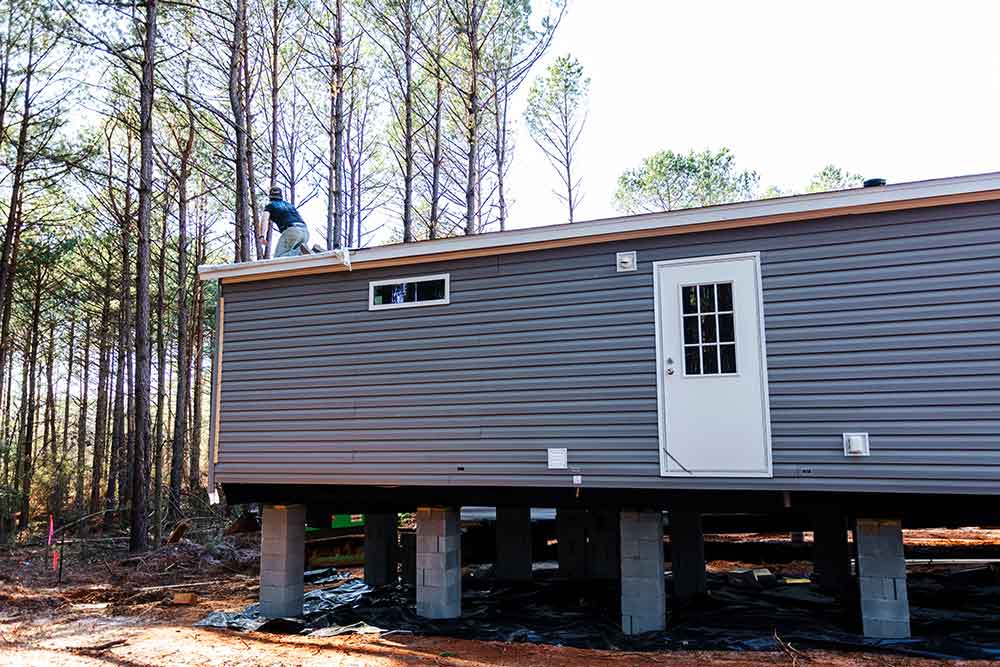
Setup includes: delivery, piers/foundation system, anchoring/tie-downs, skirting, steps/landings, and utilities (power, water, sewer/septic).
The short answer (with real numbers)
When you compare Mobile Home Setup vs. Site-Built Home Construction: Which is Faster and Cheaper?, the data strongly leans toward manufactured homes on structure cost.
On cost per square foot, Manufactured Housing Institute reports an average manufactured home cost per square foot that is roughly about half of site-built (and it also lists a site-built cost-per-square-foot figure). (MHI)
Independent research also supports a similar “roughly double” relationship in certain years based on U.S. Census data (for example, for 2021 construction costs per square foot). (Joint Center for Housing Studies)
On timeline, National Association of Home Builders summarizes U.S. Census Survey of Construction data showing that completing a new single-family site-built home averaged about 9.1 months in 2024 (from start to finish, including authorization time and construction). (eyeonhousing.org)
Manufactured home build time varies by plant and customization, but factory construction is commonly measured in days to a few weeks, with the remaining time on-site dominated by site prep, delivery scheduling, utilities, and inspections. (newhomesource.com)
So—Mobile Home Setup vs. Site-Built Home Construction: Which is Faster and Cheaper?
Usually: manufactured is faster and cheaper, but “cheaper” depends on your land and your financing.
A side-by-side comparison (high-level)
| Category | Manufactured (Mobile) Home Setup | Site-Built Home Construction |
| Build environment | Factory-controlled | Outdoor job site |
| Weather delays | Minimal during build | Common |
| Typical build timeline | Factory build + setup (often weeks to a few months total, depending on site work) | Often many months (national average around 9 months in 2024) |
| Structure cost per sq ft | Usually lower | Usually higher |
| Site work impact | High (land + utilities can swing total cost a lot) | High (also significant) |
| Financing | Can be chattel/personal property or mortgage if real property | Usually mortgage |
| Resale/value | Depends on land ownership + titling + quality + market | Often stronger “conventional” resale pathway |
(See the citations in the sections below for the cost and time benchmarks.) (MHI)
Why manufactured homes are usually faster
1) Factory work runs in parallel with your site prep
This is the single biggest timeline advantage.
With a site-built home, you can’t really “build the house” while the lot isn’t ready. With manufactured housing, the home can be built while you are:
- clearing and grading the land
- getting septic approvals (if needed)
- running power and water
- pouring footings or setting pier supports (depending on design)
- pulling permits and scheduling inspections
That overlap can shave months off the total “idea to move-in” timeline—if you plan correctly.
2) Fewer weather delays during construction
Site-built timelines are exposed to:
- rain delays during excavation and foundation work
- framing delays during storms
- humidity affecting materials and scheduling
- subcontractor reschedules due to other job sites falling behind
Factory construction is much less sensitive to that.
3) Standardization reduces scheduling chaos
Site-built projects live and die by subcontractor sequencing: framing → rough plumbing → rough electrical → inspections → insulation → drywall → trim → final inspections.
Manufactured homes arrive with many systems already built and tested in controlled conditions, leaving your local timeline more focused on site hookups and compliance.
What actually controls the manufactured “setup” timeline
This is where families get surprised. They think setup is just “drop it on the land and done.”
In reality, Mobile Home Setup vs. Site-Built Home Construction: Which is Faster and Cheaper? becomes a site-work question.
The most common timeline drivers for a manufactured home install are:
A) Land prep (clearing, grading, drainage)
Bad drainage and uneven soil create delays—and sometimes rework—because inspectors want safe support and stable conditions.
B) Utility availability and approvals
If power is far from the site, if a pole must be installed, or if a trench is required, utility scheduling can become the long pole in the tent.
C) Septic (if not on sewer)
Septic can slow either option, but it often slows manufactured projects more than people expect because they assume “the house is quick.”
D) Inspections and scheduling
Even if the physical work takes days, inspections can add weeks if:
- the county is backlogged
- paperwork is incomplete
- contractors fail inspection and must redo work
Why manufactured homes are usually cheaper (but not always “cheap”)
Let’s separate structure cost from total project cost.
Structure cost: manufactured usually wins
On cost per square foot, the Manufactured Housing Institute publishes cost comparisons showing manufactured homes at a substantially lower average cost-per-square-foot than site-built. (MHI)
Research using U.S. Census data also finds manufactured construction costs per square foot notably lower than site-built in certain years (e.g., 2021 figures summarized in a Harvard JCHS/Pew working paper). (Joint Center for Housing Studies)
Total project cost: depends on site work + financing
Your total cost is usually:
Total cost = land + site work + home/structure + delivery/setup + utilities + permits + financing + contingency
Manufactured homes often lower the home/structure line item, but the land + site work items can be surprisingly similar across both options.
The “true cost” categories you must compare
If you want a fair answer to Mobile Home Setup vs. Site-Built Home Construction: Which is Faster and Cheaper?, compare these categories side by side:
1) Land (purchase price and readiness)
- already-owned land can favor either option
- raw land (no utilities, no driveway, no clearing) often adds substantial cost
2) Site work
Includes:
- clearing trees/brush
- grading and drainage
- driveway access
- culverts (if needed)
- retaining walls (sometimes)
- erosion control
3) Utilities
- power (pole, meter base, trenching, panel requirements)
- water (well drilling or municipal connection)
- sewer/septic
4) Foundation / support
- site-built: foundation, slab, crawlspace, etc.
- manufactured: piers/foundation system, anchoring/tie-downs, sometimes permanent foundation requirements depending on loan type
5) Permits and inspections
Manufactured homes can have both local permits and installation compliance steps. (Georgia is known for having structured manufactured housing installation oversight and permitting paths.)
6) The home/structure itself
This is where manufactured homes often pull ahead on price-per-square-foot. (MHI)
7) Financing cost over time (massive)
Your monthly payment and total interest paid can erase or amplify the upfront savings.
Financing: the part that changes the whole answer
For many families, the biggest difference isn’t cost-per-square-foot—it’s financing type.
Manufactured home financing splits into two “worlds”
- Real property mortgage financing (more like a traditional mortgage)
- Chattel/personal property financing (often higher rates, different protections)
To qualify as “real property,” the home often needs to be permanently affixed and titled as real estate (and requirements can vary).
FHA options (manufactured homes)
The U.S. Department of Housing and Urban Development outlines Title I manufactured home financing information, including borrower eligibility and program framework. (HUD)
HUD also details Title II eligibility rules for manufactured homes (including HUD Code compliance, size minimums, and other requirements). (Archivos HUD)
Conventional paths (if the home meets specific standards)
Some manufactured housing models qualify for conventional-style financing programs when they meet certain requirements:
- Fannie Mae has MH Advantage documentation describing the concept and eligibility features. (Fannie Mae)
- Freddie Mac describes CHOICEHome as a conventional financing initiative for HUD Code homes that meet prescribed specifications. (Freddie Mac)
Why this matters:
If you can finance a manufactured home like a site-built home, you often keep the “cheap structure” advantage without the “expensive loan” downside.
Insurance, taxes, and zoning differences (don’t skip this)
Even when people ask Mobile Home Setup vs. Site-Built Home Construction: Which is Faster and Cheaper?, what they really mean is: “What is my total monthly cost and resale reality?”
Insurance
- Site-built policies are usually straightforward.
- Manufactured home insurance can vary depending on:
- whether it’s in a land-lease community vs. private land
- the home’s age and construction details
- whether it meets lender requirements
- whether it’s on a permanent foundation
Property taxes
Taxes can differ based on whether the home is titled as personal property or real estate, and how the county assesses it.
Zoning and placement rules
Counties may restrict:
- minimum lot size
- minimum home size
- roof pitch/exterior requirements (sometimes)
- placement in certain zoning districts
This can affect both your timeline and your final cost.
Resale and value: do manufactured homes appreciate?
This is where old assumptions still linger.
Traditionally, some manufactured homes (especially in land-lease situations) behaved more like depreciating assets. But the story is more nuanced now.
The Urban Institute highlights data suggesting manufactured home prices have increased at nearly the same pace as site-built home prices over a long period, though the experience can vary widely by land ownership, market conditions, and home characteristics. (Urban Institute)
Practical takeaway:
If you own the land, install properly, keep documentation, and the home is financeable/resellable in your market, long-term value can be much better than the “mobile homes always depreciate” myth.
A realistic timeline breakdown (what to expect)
Below is a realistic way to compare the two timelines—without fantasy scheduling.
Manufactured home: typical phases
- Selections + order + factory schedule (can be quick or slow depending on backlog)
- Factory build (commonly measured in days to weeks, depending on customization and the manufacturer) (newhomesource.com)
- Site prep and permits (often the longest part if land is raw)
- Delivery + set + tie-downs + skirting + steps
- Utility hookups + inspections
- Punch list + move-in
Site-built home: typical phases
- Design/plans (if custom)
- Permits + financing approvals
- Site work and foundation
- Framing, rough-ins, inspections
- Drywall, finishes, trim
- Final inspections + move-in
Nationally, single-family site-built construction averaged around 9.1 months in 2024 based on Census Survey of Construction data summarized by NAHB. (eyeonhousing.org)
Important: Your local Georgia county, weather, and subcontractor availability can move these timelines substantially.
The “hidden cost” list that surprises buyers
Whether manufactured or site-built, these items commonly show up late:
For manufactured homes
- extra grading due to drainage issues
- power trenching longer than expected
- upgraded steps/handrails to meet inspection requirements
- foundation changes if lender requires a permanent foundation
- septic upgrades when the existing system is inadequate
- delivery obstacles (tight turns, soft soil, driveway limitations)
For site-built homes
- lumber/material price swings
- subcontractor availability delays
- change orders (fixtures, finishes, layout tweaks)
- weather damage during construction
- extended construction loan interest (if applicable)
Which is “cheaper” month-to-month? (a simple framework)
To answer Mobile Home Setup vs. Site-Built Home Construction: Which is Faster and Cheaper? the right way, compare monthly cost:
Monthly housing cost = (principal + interest) + taxes + insurance + utilities + maintenance + HOA/lot rent (if any)
Manufactured homes can win hard on principal amount, but:
- higher interest chattel loans can raise monthly payment
- land-lease community rent can change the equation
- insurance can vary
Site-built homes can be higher principal, but sometimes:
- stronger mortgage terms (rate/term)
- broader lender competition
- easier refinance options later
Decision guide: what type fits which family?
Choose manufactured/mobile home setup if:
- speed to move-in is a priority
- budget is tight and structure cost matters most
- you already own land (or have affordable land options)
- you can secure favorable financing (real property mortgage if possible)
- you want predictable factory quality and fewer weather delays
Choose site-built if:
- you want maximum design freedom
- you strongly prioritize long-term resale familiarity in your area
- your lot has requirements that favor site-built (HOA rules, zoning constraints)
- you’re prepared for a longer timeline and a higher upfront cost
Mobile Home Setup vs. Site-Built Home Construction: Which is Faster and Cheaper?
Manufactured often wins on speed and upfront structure cost—but site-built can win on conventional resale pathway and financing simplicity depending on your scenario.
Georgia-specific considerations (practical, not theoretical)
Even though the timeline and cost principles are national, Georgia projects have a few recurring realities:
- County-level permitting and inspections can be a timeline driver (especially septic and power coordination).
- Rural land can mean bigger utility costs (power runs, wells, septic).
- Access matters—delivery routes and driveway stability can add real costs.
If you’re in Georgia and trying to decide, treat it like a project plan: map out permitting, septic, power, driveway access, and drainage before you “fall in love” with a home model.
FAQ
Is a mobile home always faster than a site-built home?
Usually, yes—especially if your land is already prepared with utilities. But raw land can erase the speed advantage if septic, power, and grading become long-lead items.
Is a mobile home always cheaper than a site-built home?
The structure is usually cheaper per square foot, but total project cost depends on land and site work. Cost-per-square-foot comparisons from MHI and Census-based research show a significant gap in structure cost.
Can I get FHA financing for a manufactured home?
HUD provides Title I manufactured home financing information and Title II eligibility standards (including HUD Code compliance and other requirements). (HUD)
Do manufactured homes appreciate?
They can—especially when land is owned and the home is properly installed and financeable. Urban Institute analysis shows manufactured home prices have grown at nearly identical rates to site-built homes over a long period, though outcomes vary by situation.
Bottom line
So, Mobile Home Setup vs. Site-Built Home Construction: Which is Faster and Cheaper?
- Faster: Manufactured home setup usually wins because factory construction compresses the timeline and avoids many weather delays.
- Cheaper (structure): Manufactured homes usually cost far less per square foot than site-built homes.
- Cheaper (total project): Depends on land, utilities, septic, permits, and—most importantly—financing type.
If you want the best of both worlds, the “sweet spot” is often:
- land you own (or low-cost land with nearby utilities),
- a manufactured home that qualifies for real-property financing,
- clean permitting and inspection documentation,
- solid drainage and driveway access.
That’s how Mobile Home Setup vs. Site-Built Home Construction: Which is Faster and Cheaper? becomes: “manufactured is faster, and it stays cheaper.”