
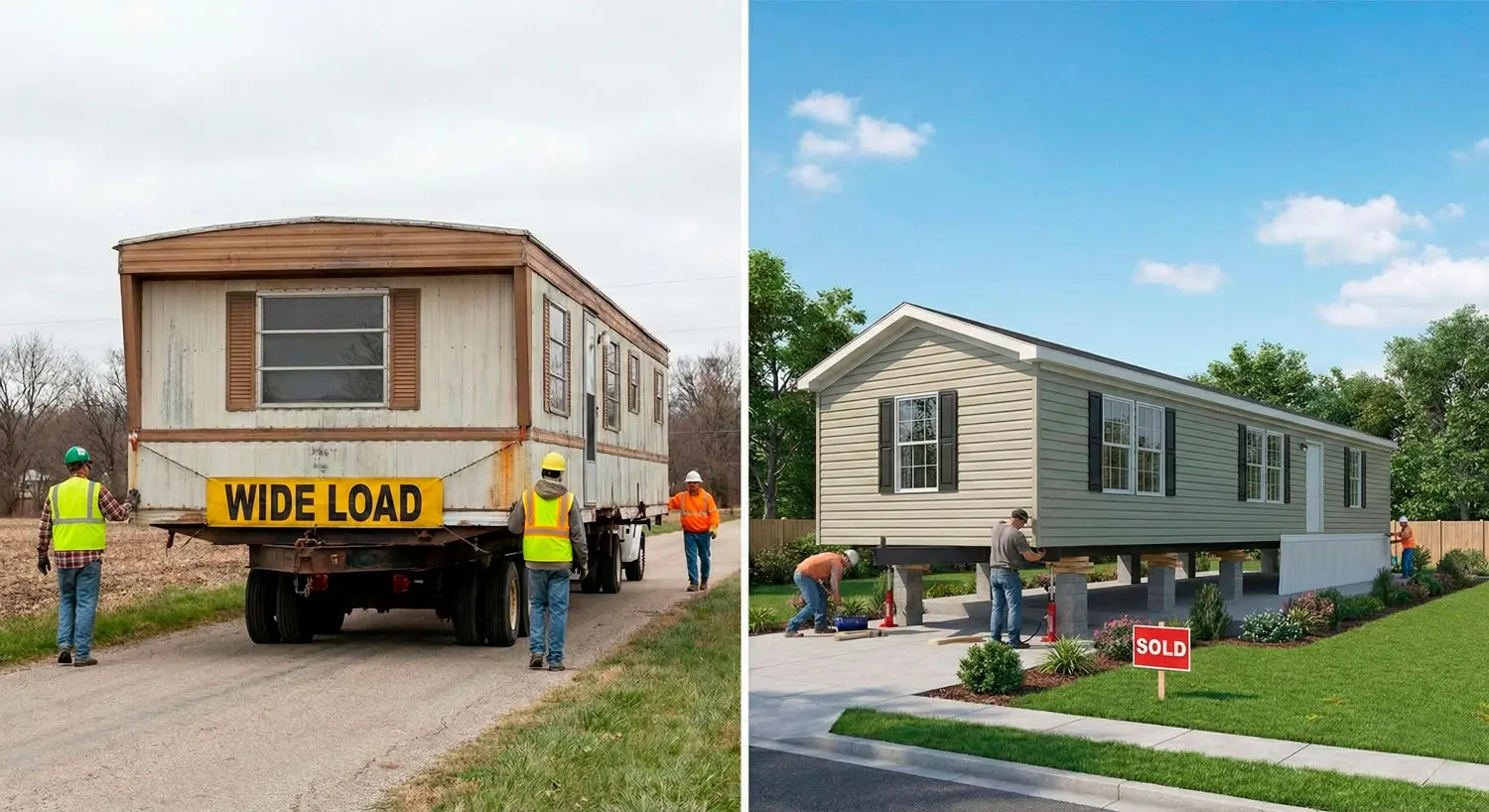
Whats the best road, to Move an Older Mobile Home or Buy New? A Decision Guide for Buyers Who Found a Used Home Off-Site
You found a used manufactured home sitting on someone else’s property, and the price looks like a steal—until you remember you have to move it. The hard part isn’t the decision in your head; it’s the unknowns: transport risk, hidden rehab needs, and what lenders will (and won’t) finance. This guide walks you through the questions that prevent expensive regret before you put money down.
If you want a simple way to think about it: this isn’t really “used vs new.” It’s “how many unknowns can you tolerate” versus “how much certainty do you need.”
The real choice isn’t used vs new—it’s risk vs certainty
Most buyer regret doesn’t come from choosing the “wrong” home. It comes from choosing a path that had hidden requirements they didn’t price, schedule, or verify.
A used home off-site can be a great deal—sometimes. But the number on the listing rarely includes:
- Getting the home out of its current location (access and removal constraints)
- Transport and delivery logistics (route and timing realities)
- Setup after arrival (leveling, anchoring, and whatever foundation approach applies for your situation—TBD)
- Site readiness on your land (access, drainage, soil, utilities—some items TBD)
- Repairs that were invisible during a walkthrough (under-home systems, moisture history, deferred maintenance)
A new home usually costs more upfront, but you’re paying for fewer unknowns and less deferred maintenance. You still have site costs, but the “home condition” portion is more predictable.
Why buyers regret the decision (it’s the unknowns, not the sticker price)
Here’s the pattern that creates regret:
- The buyer compares list price only
- They underestimate “move + setup + rehab”
- They discover the deal-breakers after money is committed
- The project turns into delays, change orders, and stressful tradeoffs
The best decision is the one you can verify the most before you sign.
A fast decision filter before you fall in love with the used home
Before you negotiate, pay a deposit, or start planning your land around a used home, run a quick filter. The goal is to catch “no-go” signals early.
When “move it” is usually a bad idea (deal-breaker signals)
Moving an older manufactured home is often a bad bet when the home’s condition or context creates high uncertainty. Common deal-breaker signals include:
- The home’s current location makes removal difficult (tight turns, narrow access, obstacles, steep grades)
- You can’t get credible answers about the home’s history (age, prior leaks, prior moves, major repairs)
- The home shows obvious signs of deferred maintenance during a basic walkthrough (soft floors, widespread staining, strong musty odors)
- The seller can’t (or won’t) allow a thorough look underneath or at key systems (access constraints, blocked areas)
- The timeline is compressed and you need guaranteed occupancy by a certain date (moving + setup + repairs rarely behave like “guaranteed” schedules)
Some homes may not be practical to move depending on condition, access, and requirements. If you can’t verify the basics, your risk goes up fast.
When moving can make sense (the conditions that reduce risk)
Moving an older home can be rational when:
- You can inspect enough of the home to understand what you’re buying (including under-home visibility where possible)
- The home appears structurally “move-ready” in a practical sense (no obvious severe distress—still requires verification)
- Access at the pickup site and delivery site is workable (or can be made workable)
- You’re comfortable with variability in budget and schedule, and you have a contingency plan
- You’re buying it at a price that still makes sense after adding realistic move + setup + repair allowances
In other words: moving can make sense when you’re buying a known scope, not a mystery.
Option A—Move the older home: what you’re actually buying
If you choose to move the used home, you’re not just buying a structure. You’re buying a project that has logistics, site work, and repair risk baked in.
Transport risk (structure, route, timing)
Transport risk isn’t just “will it get there.” It’s:
- Can the home be removed from its current site without damage? (access, obstacles, tight turns)
- Is the route workable for transport? (timing, restrictions, distance—details vary)
- Does the home’s condition increase the chance of damage during transport? (unknowns rise with age and deferred maintenance)
- What happens if the schedule slips? (weather, site readiness, coordination delays)
A key mindset shift: even a careful move can reveal weaknesses that were hidden while the home was sitting still. That doesn’t mean moving is always a mistake; it means you should treat transport as a meaningful risk category, not a line item.
Setup scope after arrival (leveling, anchoring, foundation approach TBD)
After the home arrives, it still has to become stable, usable, and “ready” for whatever verification your situation requires.
Setup commonly involves:
- Placement and alignment on the site
- Leveling/re-leveling and stabilization
- Anchoring/tie-down considerations
- Foundation approach appropriate to your situation (TBD — depends on site, home, and any lender/inspection requirements)
The important part for decision-making is not the terminology. It’s recognizing that “delivery” is not the finish line.
Rehab vs “minor fixes” (where surprises hide)
This is where buyers most often underestimate the all-in cost.
What buyers think they’re buying:
- “A clean used home with a few small fixes.”
What they may actually be buying:
- Deferred maintenance that becomes obvious once the home is moved and reconnected
- Moisture history that shows up in underbelly/insulation, subfloor areas, or around bathrooms/kitchen
- Cosmetic issues that were hidden by furniture or staging
- Under-home system issues that weren’t visible during a walkthrough
You don’t need to assume the worst. You do need to budget like surprises are possible—and verify as much as you can before committing.
Option B—Buy new: what you’re paying for
Buying new is not “easy mode,” but it usually gives you a more predictable scope.
What “new” reduces (unknowns, deferred maintenance)
New tends to reduce:
- Unknown repair history
- Hidden moisture legacy issues
- Prior patchwork fixes
- The risk that transport reveals long-standing weaknesses (you still have transport, but the home is new)
You’re essentially paying to avoid inheriting someone else’s problem stack.
What “new” doesn’t solve (site prep, utilities, access, drainage)
A new home still depends on your site. Many of the toughest issues are land-related:
- Driveway and access constraints
- Soil and drainage realities
- Utilities readiness (what’s available, where it runs, who coordinates what—TBD)
- Local permitting requirements (TBD)
- Timeline coordination
So “new” doesn’t eliminate complexity. It shifts more of the complexity toward site readiness and less toward home condition uncertainty.
Contrarian moment: the cheapest path is often the one with the fewest unknowns
A low listing price can make a used home feel like the obvious choice. But cheap becomes expensive when scope is unclear.
Why predictable scope beats optimistic estimates
When you buy a used off-site home to move, you’re relying on assumptions:
- It’s “move-ready”
- It won’t need major repairs
- The site is “basically ready”
- Financing will work out
If even one of those assumptions fails, the savings can evaporate.
A more regret-resistant approach is to pick the path where:
- You can verify more before committing
- You can describe the scope clearly to contractors
- You can build a budget that includes contingency without panic
The “two-budget” trap: move budget + rehab budget
Many buyers only plan one budget: “the move.”
In reality, you should plan two:
- Move + setup budget (transport + stabilization + site readiness items you can confirm)
- Rehab/repair budget (repairs you already see + contingency for the ones you don’t)
If you can’t afford both budgets—on paper—moving the older home may not be the safer choice.
Financing implications buyers miss (and how to ask the right questions)
Financing is where “I’ll figure it out later” can become a deal-breaker. Rules vary by lender and loan type; confirm in writing before committing.
Why a moved home can trigger lender conditions (varies)
Some lenders are cautious about moved homes because they want clear verification of stability, installation, and condition. The specifics vary, and your situation may involve different requirements depending on the loan type and property details.
What matters for your decision:
- Don’t assume a lender will treat a moved home the same as a never-moved home.
- Don’t assume verbal reassurance is enough.
- Don’t wait until after you’ve paid deposits to ask detailed questions.
The call script: what to ask before you put money down
When you talk to a lender (or a loan officer), don’t ask: “Can I finance it?” That invites a vague yes.
Ask questions that force clarity:
- “I’m considering moving a used manufactured home from an off-site location onto my land. Are there restrictions or special conditions for a moved home in your program?”
- “What documentation do you typically require related to installation, anchoring, or foundation? Please tell me exactly what you need so I don’t order the wrong thing.”
- “Are there age, title, or classification issues I should know about for a used home being relocated?” (varies)
- “If the home needs repairs after transport, does that affect financing or approval timelines?”
- “Can you put your requirements in writing or point me to the program guidelines you follow?”
If the lender can’t answer clearly, treat that as information—not as a reason to gamble.
Common problems after moving an older home (and how to reduce them)
Buyers often report a mix of cosmetic adjustments and occasional repair needs after transport. Some issues are minor; some reveal deeper deferred maintenance.
Post-move cosmetic vs structural issues
Cosmetic issues can include:
- Trim cracks, drywall seams opening, minor finish damage
- Doors that need adjustment
- Flooring shifts or squeaks that weren’t noticeable before
More serious issues (not guaranteed, but possible) can include:
- Evidence of movement that requires stabilization work
- Under-home material damage (underbelly/insulation disruptions)
- Stress points that show up around windows, doors, and utility penetrations
How to reduce risk:
- Verify as much as you can before moving (especially moisture history and under-home visibility where possible)
- Budget for post-move adjustments as normal
- Use clear scope language with contractors: “stabilize, level, verify” rather than “make it perfect”
Utility reconnections and under-home systems (TBD boundaries)
Utility connections and who handles what can vary by project and trade scope (TBD). For decision-making, assume:
- There may be coordination between multiple trades
- Utility readiness on your land is a major schedule driver
- Under-home systems are where surprises may appear after the move
Your best move is to get clarity early on what is included vs coordinated vs excluded—before you commit.
Moisture/drainage and re-settlement risk
Moisture is a repeat offender. Even a good move can suffer if the site holds water or drainage routes water toward the home.
Practical risk reducers:
- Walk the site after rain if possible
- Identify low spots and pooling areas
- Plan downspout discharge and surface water routing early
- Don’t treat skirting or cosmetic perimeter work as a substitute for drainage
If moisture problems show up after installation, they can create an ongoing maintenance cycle that’s far more expensive than addressing drainage upfront.
The questions to ask before buying a used manufactured home to move
If you want fewer regrets, ask questions that reveal the hidden scope. This section is designed to be copy/paste friendly for your notes.
Seller questions (paperwork, age, prior moves, known issues)
Ask the seller:
- How old is the home? Do you have documentation? (title/records—TBD what’s available)
- Has the home ever been moved before? If yes, when and why?
- Are there known leaks (roof, plumbing, windows)? What was repaired and when?
- Any history of soft floors, mold, musty odors, or recurring moisture?
- Can I see underneath the home (or have someone inspect it) before purchase?
- What’s included in the sale (appliances, HVAC, skirting, steps, etc.)?
If answers are vague, treat that as a risk signal. Uncertainty is part of the “price.”
Site questions (access, soil, drainage, utility readiness)
Ask about your land:
- Can a transport route reach the placement location without tight turns or obstacles?
- Is the driveway/entry strong enough and wide enough for equipment access? (TBD specifics)
- How does water move across the site after rain? Where does it pool?
- Is the placement area level or will grading be needed?
- What utilities are available, where are they located, and what work is required to connect? (TBD)
- Are there permitting steps or local requirements that could affect timing? (TBD)
If your land isn’t ready, the cost/time of “moving a home” can balloon even when the home itself is fine.
Contractor questions (scope clarity, timeline, evidence you’ll get)
Whether you’re talking to a mover, installer, or setup team, ask:
- What information do you need to assess move risk (photos, addresses, access notes)?
- What’s included in your scope versus excluded or coordinated with other trades?
- What could cause delays or change orders in my situation?
- What proof will I receive when work is complete (photos, notes, documentation)?
- If my lender requires specific wording or documentation, how do we avoid ordering the wrong deliverable?
A buyer who can describe the scope clearly gets better answers—and usually fewer surprises.
A simple decision worksheet: choose the path you can verify
This worksheet isn’t about perfection. It’s about forcing an apples-to-apples comparison.
Compare apples-to-apples: all-in cost, timeline, risk flags
Create two columns: “Move Older Home” and “Buy New.”
Under each, list:
- Home cost
- Used purchase price vs new purchase price
- Move + setup
- Transport (TBD based on distance/access)
- Setup/stabilization scope (leveling, anchoring, foundation approach TBD)
- Site prep you can confirm (grading/drainage/access)
- Repairs / rehab
- Known repairs (you can see them)
- Likely repairs (based on age/condition signals)
- Contingency allowance (a buffer you can live with)
- Financing clarity
- Lender requirements known in writing? Yes/No
- Documentation requirements clear? Yes/No
- Timeline tolerance
- Do you have a hard move-in date? Yes/No
- Do you have a backup plan if delays happen? Yes/No
Then mark risk flags:
- Access constraints at pickup site
- Access constraints at your land
- Moisture/drainage concerns
- Limited ability to inspect/verify
- Financing uncertainty
If your worksheet has too many “unknown” boxes, your safest next step is to pause and gather information—not to guess.
Next steps depending on your choice
If you choose Move Older Home:
- Verify access at both sites
- Gather photos and basic details for a move/setup assessment
- Talk to the lender using the script and get requirements in writing
- Budget for post-move adjustments and repair contingency
If you choose Buy New:
- Focus on site readiness (access, drainage, utilities)
- Confirm delivery/setup timeline dependencies
- Budget for the site work that new doesn’t eliminate
Low-friction next step (Georgia): get a move/setup reality check before you commit
You found a used home off-site and you’re trying to decide before you commit money. If you want a reality check on move risk, site constraints, and what setup could involve, send photos of the home, the pickup/delivery addresses, and a few site notes (access, slope, drainage). We’ll help you spot deal-breakers early and clarify what can be verified before closing. Call Superior Mobile Home Setup to discuss transport and installation planning in Georgia.
“Send photos + address + site notes” intake
To make the first call productive, have:
- A few exterior photos (all sides if possible)
- Any under-home photos you can safely get (if accessible)
- Pickup address and details about access (tight turns, obstacles)
- Delivery address and a few notes about your land (driveway, slope, drainage)
- Any lender notes or requirements you’ve received (if financing)
What Superior Mobile Home Setup can typically help with vs out-of-scope (TBD)
Superior Mobile Home Setup’s core public positioning is transport and installation planning in Georgia, with a process-driven approach that emphasizes scope clarity and avoiding rework. Exact inclusions and exclusions vary by project (TBD), especially around utilities and permitting. The safest approach is to confirm scope early so you don’t assume something is included when it isn’t.
FAQ content
- Is it worth moving an older mobile home?
It can be, but only when the home’s condition and both sites (pickup and delivery) are verifiable enough to reduce surprises. If access is difficult, the home has unknown moisture history, or financing requirements aren’t clear, the risk often outweighs the savings. - What are the risks of moving a 20-year-old manufactured home?
Age can be a proxy for unknowns: deferred maintenance, prior repairs, moisture history, and wear that may not show up until transport and reinstallation. The biggest risks are paying for the move and then discovering repair scope or verification requirements you didn’t budget for. - Can you finance a manufactured home that has been moved?
Sometimes, but rules vary by lender and loan type. The best move is to ask your lender specific questions early and get requirements in writing before you pay deposits or sign contracts. - What are common problems after moving an older mobile home?
Buyers often see post-move adjustments like minor finish cracking, door alignment issues, and cosmetic repairs. Depending on condition and site factors, some may also face under-home issues (moisture, insulation/underbelly disruptions) or stabilization needs. - What should I inspect before buying a used manufactured home to move?
Try to verify moisture history, general condition, and under-home visibility where possible. Ask about prior moves, prior leaks, and major repairs. Also verify access at the pickup site and your land—because access constraints can turn a “good deal” into a logistical problem. - When is buying a new manufactured home the smarter choice?
Buying new is often smarter when you need a predictable timeline, want fewer unknown repairs, or can’t confidently verify the used home’s condition and financing requirements. You’ll still need site prep and utility planning, but you’re generally reducing the “hidden rehab” risk.
You found a used home off-site and you’re trying to decide before you commit money.
If you want a reality check on move risk, site constraints, and what setup could involve, send photos of the home, the pickup/delivery addresses, and a few site notes (access, slope, drainage).
We’ll help you spot deal-breakers early and clarify what can be verified before closing.
Call Superior Mobile Home Setup to discuss transport and installation planning in Georgia.