
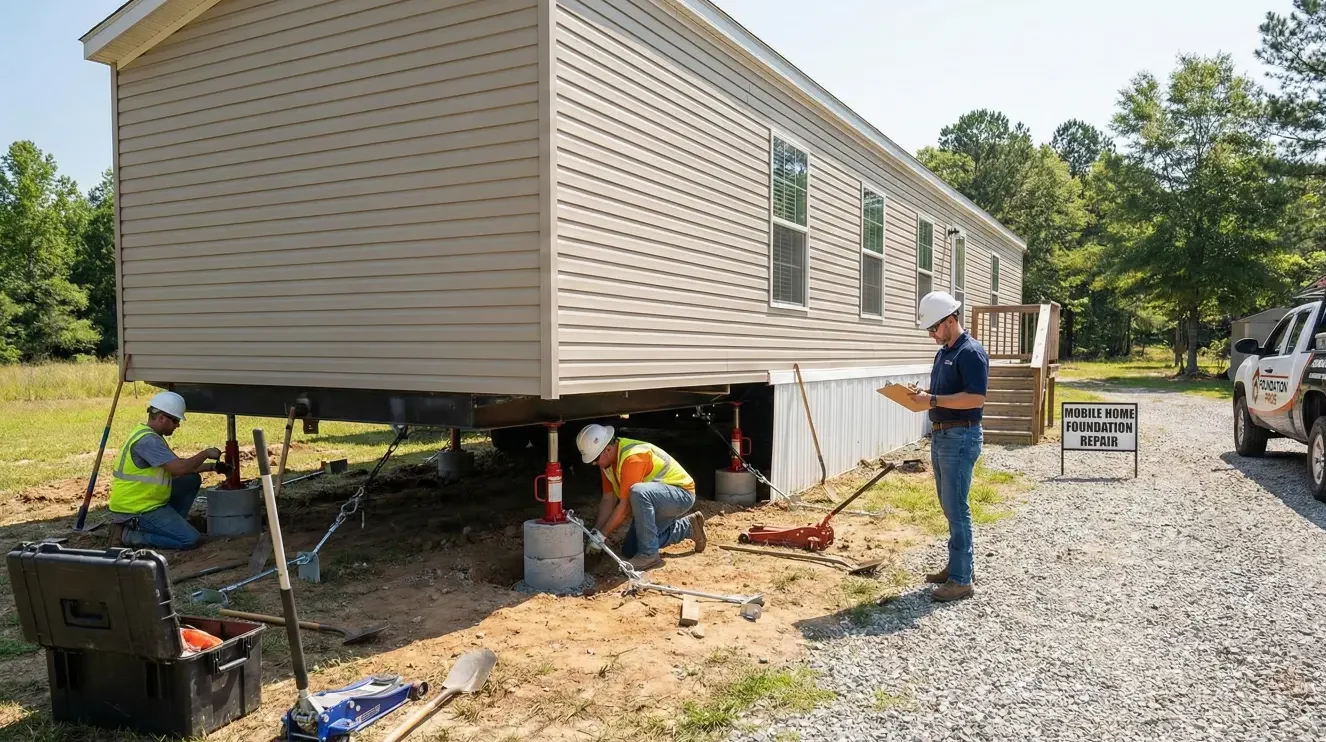
If you’re searching “fix mobile home foundation for loan”, you’re probably under deadline pressure. A lender has flagged something, a closing date is moving closer, and you’re trying to figure out what actually needs to be fixed—without paying for work that doesn’t help.
Here’s the key distinction that keeps projects from spiraling: lender conditions usually require (1) corrections and (2) documentation. Sometimes you truly need foundation corrections. Sometimes you mostly need the right paperwork to prove what already exists. And often, it’s a mix. Requirements vary by lender and loan type, so the fastest path is to stop guessing and work directly from the lender’s exact condition language.
This guide gives you a decision tree for the most common condition types, a “fix-first” prioritization logic, and an inspection readiness plan so you can move the loan forward with fewer surprises—without promising approval outcomes that depend on lender review.
Answer First: What Lenders Typically Need (and What They Don’t)
Corrections vs documentation
When a lender flags “foundation” or “anchoring,” it helps to translate the request into two buckets:
Corrections (physical work):
Work that changes the condition of the home or its support system—releveling, anchoring adjustments, repairs to supports, or addressing visible deficiencies that block inspection.
Documentation (proof and clarity):
Information that allows the lender/inspector to verify what’s already present—photos, notes, reports, and sometimes an engineer report for manufactured home foundations depending on what the lender requires.
The most expensive mistake isn’t “doing nothing.” It’s doing the wrong thing first—like paying for cosmetic work when the inspection is failing for a structural or anchoring issue, or scheduling a reinspection without documenting completed repairs.
The “don’t guess—use the condition language” rule
Before you schedule work, get the lender’s condition wording in writing (email or portal screenshot). Then use it as the routing document for your plan.
A quick rule that saves time:
If you can’t repeat the lender’s condition back in one sentence, you’re not ready to scope work yet.
What to ask your lender (brief and specific):
- “What exact document or verification are you requesting?”
- “Who must sign it (engineer, inspector, contractor)?”
- “Is this a repair requirement, a documentation requirement, or both?”
You don’t need to be an expert—just the person who makes the requirement unambiguous.
Decision Tree: Read Your Lender Condition and Choose the Right Path
This section is a practical flow. Start with the lender’s exact wording, then choose the path that matches it. If your wording doesn’t match any branch cleanly, that’s a signal to clarify with the lender before spending money.
If it says “foundation”…
Common meaning: The lender is concerned about structural stability, support, permanence, or the condition of the foundation system. Requirements vary by lender and loan type.
Start here:
- Ask: is it a condition issue or a documentation issue?
- If the home is visibly out of level, has obvious support problems, or shows deterioration, it’s likely corrections-first.
- If the home appears stable and the lender is asking for “verification,” it may be documentation-heavy.
- Confirm what “foundation” means in their wording.
“Foundation” can be used loosely. The lender may be referencing supports, piers, skirting misinterpretations, anchoring, or permanent foundation language. - Choose your next action:
- Corrections-first path: get a scoped plan for foundation corrections, then document the completed work for the lender/inspector.
- Documentation-first path: gather evidence (photos/notes/prior documents) and confirm whether an engineer report for manufactured home foundations is required.
Good scope question to ask a provider:
“What conditions would prevent you from signing off or documenting this on the first visit?”
If it says “tie-down/anchoring”…
Common meaning: The lender/inspection wants proof that the home is properly anchored, or they’ve found a deficiency. Anchoring and tie-down terms are often used interchangeably in conversation, but the lender’s wording is the boss.
Start here:
- Determine whether it’s missing/deficient anchoring or missing proof.
- “Repair/replace/install anchors” suggests corrections.
- “Provide documentation of anchoring” suggests documentation.
- Look for trigger words:
- “Non-compliant,” “insufficient,” “missing,” “repair required” → corrections likely.
- “Certification,” “verification,” “documentation” → documentation likely.
- Choose your next action:
- Corrections-first path: correct anchoring deficiencies, then keep documentation for reinspection and lender file.
- Documentation-first path: confirm what evidence is acceptable (photos, inspection notes, reports).
Good scope question to ask a provider:
“What do you document after the work is completed so the lender has what they need?”
If it says “inspection failed”…
Common meaning: Something visible or measurable didn’t meet the inspection criteria, or the inspector noted conditions that the lender won’t accept without resolution.
Start here:
- Ask for the inspection notes and identify the fail items.
Not “the inspection failed” in general—why it failed. - Split fail items into “stop the process” vs “secondary.”
- Stop items are often structural/safety/access issues that block progress.
- Secondary items are often finish-related or easily resolved once the stop items are handled.
- Choose your next action:
- Stop-items-first path: fix what blocks reinspection and lender acceptance, then address secondary items.
- Documentation path: confirm how the inspector wants evidence of completion (photos, receipts, notes).
Good scope question to ask before rescheduling:
“What will the inspector need to see or receive to mark this as resolved?”
Readiness Rubric: Ready / Almost / Not Yet
This rubric is designed to keep you from scheduling the wrong next step. Use it as a self-assessment before you pay for a visit or commit to repairs.
Ready: what you already have
You’re “Ready” if you can answer yes to most of these:
- You have the exact lender condition language in writing.
- You have inspection notes (if an inspection failed) and can list the specific fail items.
- You can provide clear photos of the areas tied to the condition (supports, access points, anchoring areas where visible/safe).
- You know whether you need corrections, documentation, or both.
- You can provide basic site details (access constraints, who will be present, any hazards).
If you’re Ready, the next step is simple: request an estimate with the lender condition language and your current documentation, so the scope is based on reality—not assumptions.
After you’ve checked “Ready,” here’s a clean next step if you want to move fast without overcommitting:
You can send the lender condition wording and a few photos so we can tell you what’s likely a correction versus a documentation task—and what we’d need to scope it responsibly.
Get a Quote
Call Us
Almost: the 2–3 blockers to clear
You’re “Almost” if you’re missing just a few items that prevent accurate scoping:
- You don’t have the lender’s condition wording (or it’s vague).
- You have an inspection fail, but not the specific notes or photos.
- You’re not sure whether the lender expects repairs, documentation, or an engineer report for manufactured home foundations.
Your next step: clear the missing inputs before paying for a reinspection or rushing into work.
A common “Almost” fix list:
- Get the condition wording in writing.
- Request the inspection notes.
- Take basic photos and confirm access.
Not yet: the safe next step
You’re “Not yet” if any of these are true:
- You’re trying to “do a cheap patch just to pass” without knowing the actual condition trigger.
- The home has obvious safety/structural concerns and you’re still collecting basic information.
- You’re scheduling reinspection without confirming what evidence of repairs is required.
Your next step: prioritize safety and clarity first. If there are visible structural concerns, consult a qualified professional. Requirements vary by lender and loan type, and outcomes depend on lender review—so protect yourself from spending money in the wrong order.
What Commonly Goes Wrong
This section is intentionally blunt. These are failure modes that create reinspection loops and wasted spend—especially when people are trying to protect a closing date.
Failure mode table (why it happens; consequence; prevention)
| Failure | Why | Consequence | Prevention |
| Fixing “what looks bad” instead of what the lender flagged | Homeowners interpret the condition as cosmetic | Money spent; condition still unmet; delays | Start with the lender’s exact condition language and map work to it |
| Scheduling reinspection before work is inspection-ready | Deadline pressure; unclear “done” criteria | Failed reinspection; more fees; credibility hit | Use an inspection readiness checklist and confirm what the inspector needs |
| Treating documentation as optional | “If it’s fixed, that should be enough” | Lender can’t verify; file stalls | Capture photos, notes, and keep proof of completed work |
| Partial fixes that don’t address the root issue | Trying to minimize spend without full scope | Condition persists; secondary issues arise | Prioritize structural/safety first; address the true trigger item |
| Incorrect assumptions about who must sign off | “Any contractor letter will work” | Document rejected; more time lost | Confirm signer requirements with lender; requirements vary |
| Ignoring access constraints | Underestimating under-home access and safety | Rescheduled visits; incomplete evaluation | Clear access; disclose constraints up front; prep the site |
“Partial fixes” that trigger reinspection
Partial fixes are tempting because they feel fast. They often backfire because they don’t satisfy the lender’s condition or the inspector’s verification needs.
Common examples of “partial fix thinking”:
- Leveling without addressing the underlying support issue.
- Completing work but failing to document it.
- Solving one visible issue while the lender condition was about a different component.
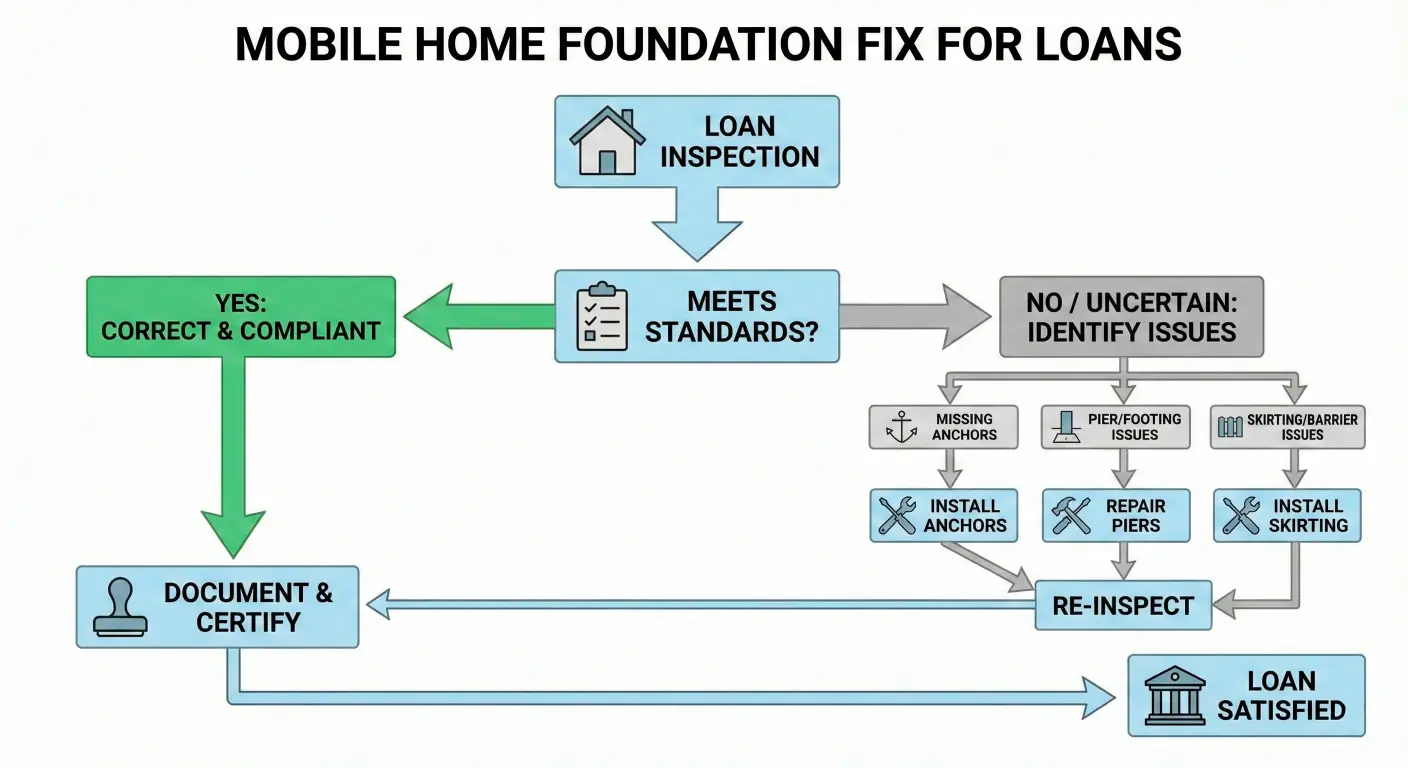
A better approach is sequence-driven: interpret condition → identify required work → complete work fully → document → reinspection.
Cost Drivers
You asked for a fix plan, not a price guess. This section explains what typically changes the scope (and therefore cost), without inventing numbers.
Scope complexity drivers
These factors commonly expand scope:
- Ambiguous lender language (creates rework risk unless clarified)
- Multiple conditions bundled together (foundation + anchoring + inspection failures)
- Prior incomplete work (repairs that weren’t documented or weren’t done to the standard the inspector expects)
- Unclear “done” criteria (no agreement on what counts as resolved)
A practical takeaway: the more your request is “fix it for loan approval” without the lender’s exact wording, the more time gets spent translating what’s required.
Site access and hidden conditions
Two more scope drivers that surprise people:
- Access limitations: If areas can’t be safely observed, the professional can’t verify conditions. This can force rescheduling or limitations in what can be documented.
- Hidden conditions: Some issues only become visible once access is gained or once work begins. That’s why responsible scoping includes assumptions—and why no one should promise a guarantee of lender acceptance.
If you want fewer surprises, treat access and documentation as part of the work—not as “extra.”
Inspection-Readiness Checklist
This checklist exists for one purpose: help you avoid the reinspection loop.
Before scheduling reinspection
- Confirm the exact fail items or condition language (in writing).
- Ensure the work addresses the trigger item, not just visible symptoms.
- Make the site accessible and safe to view relevant areas.
- Walk through a “verification mindset”:
- “If I were inspecting this, what would I need to see to mark it resolved?”
- Confirm what evidence the inspector/lender expects:
- photos, notes, receipts, professional report, etc.
Fix-first prioritization logic (must-use):
- Safety/structural integrity first (stop-the-process items)
- Compliance/verification items next (anchoring, documentation requirements, lender wording)
- Cosmetics last (only if they’re explicitly tied to the condition)
Documentation to keep
Keep a simple file—digital is fine:
- Photos before, during, and after work (clear, well-lit, dated if possible)
- A short written summary of what was done (scope notes)
- Any reports or inspection notes tied to the condition
- Any communication from the lender clarifying requirements
This isn’t bureaucracy. It’s the evidence the file needs to move.
Proof Posture: What Evidence Matters
The lender’s job is to reduce risk. Your job is to reduce uncertainty.
What to capture (photos, notes, reports)
Capture evidence that maps directly to the lender condition language:
- Photos that show the relevant condition clearly (not just “the area”)
- Notes that connect work performed to the lender’s wording
- Any report/letter the lender requested, if applicable
If a lender asks for a specific document type, don’t replace it with a generic letter. Requirements vary by lender and loan type, and a mismatch can stall the file even if the work was completed.
How to communicate with lender/inspector
Use short, clear language:
- “Here is the condition wording.”
- “Here is what was corrected.”
- “Here is the documentation that supports the correction.”
- “Here is what is ready for reinspection.”
Avoid long explanations. The file moves when the proof aligns.
Next Step: Get a Quote With the Right Inputs
What we’ll ask you for
To scope responsibly (and avoid the “cheap patch” trap), expect to be asked for:
- The lender’s exact condition language
- Any inspection notes if an inspection failed
- Photos of the relevant areas (foundation/anchoring/access points where safe)
- Your target closing timeline (so we can advise what’s realistic without promising outcomes)
- Your loan type (if known) or at least what the lender is calling for
If you don’t have all of it, that’s okay—just say what’s missing so the plan can start with clarification, not assumptions.
How we scope work responsibly
Responsible scoping means:
- Translating lender language into a sequence of actions
- Identifying what’s likely correction vs documentation
- Stating scope assumptions clearly (so surprises are minimized)
- Avoiding guarantees—because lender acceptance depends on lender review
If you want a quote that actually helps you move the loan forward, send the condition wording and your current documentation first. We’ll tell you what’s needed, what’s not, and what the next step should be—without pretending we can control lender decisions.
What happens next: We’ll review your lender’s condition language and your photos/notes, identify the most likely scope drivers, and outline a fix-first sequence that reduces reinspection risk.
FAQ
Approval & guarantees
Will foundation repair guarantee loan approval?
No—loan approval depends on lender underwriting and review. Repairs and documentation can address specific conditions, but requirements vary by lender and loan type. What to do next: Ask your lender what condition(s) must be cleared and what proof they will accept.
Getting a quote
What information should I send for a quote?
Send the lender’s exact condition language, any inspection notes, and clear photos of the relevant areas. Include your target closing date so scope can be prioritized without promising outcomes. What to do next: Gather those items into one message so scoping starts from evidence, not assumptions.
Engineer reports & documentation
Do I need an engineer report for my lender?
Sometimes a lender requests an engineer report for manufactured home foundations; other times they accept different documentation. Don’t guess—confirm who must sign the document. What to do next: Ask your lender, “Who must sign the documentation you’re requesting?”
Timing & reinspections
What’s the fastest way to avoid reinspection delays?
Don’t reschedule until the trigger items are fully resolved and you can document completion. Access, visible conditions, and completeness matter. What to do next: Use the inspection readiness checklist and confirm what evidence the inspector expects.
Anchoring and tie-down issues
Can tie-down issues block financing?
They can if the lender/inspection identifies anchoring/tie-down deficiencies or requires verification. Requirements vary by lender and loan type. What to do next: Match your repair plan to the exact condition wording and keep documentation of completed corrections.
Leveling vs repair decisions
How do I know if I need releveling vs repair?
Releveling addresses level/settlement symptoms; repair addresses underlying support or component issues. The right choice depends on what the lender/inspection flagged and what’s visible on-site. What to do next: Start with the lender condition language, then have a qualified professional assess what’s actually required to clear it.