
Many homeowners assume a manufactured home can be moved and installed the same way anywhere. It is easy to see why. If the home was anchored properly at the old location, the natural assumption is that the same setup should still work after the move.
But that is not always how it works.
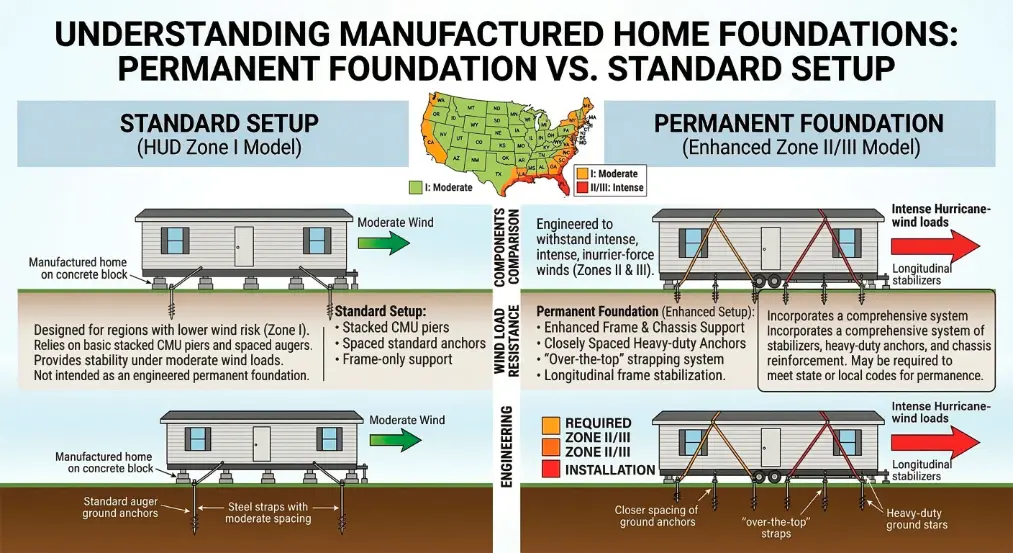
HUD wind zones affect how manufactured homes are designed and how they may need to be secured once they are installed. When a home moves from a lower-wind inland area to a county with greater wind exposure, the anchoring system may need to change. That can affect tie-down spacing, the number of anchors, the type of straps used, and whether additional components are needed as part of the installation.
For a homeowner, this usually becomes real at exactly the wrong moment: after land has been purchased, transportation has been scheduled, and someone in the process mentions Wind Zone 2 or Wind Zone 3 requirements. Suddenly, what looked like a straightforward move becomes a question of safety, documentation, and whether the installation will meet the applicable requirements for the new site.
The good news is that this does not have to feel mysterious. Once you understand what HUD wind zones are, why tie-down requirements change, and how installers verify what is needed, the situation becomes much easier to manage.
This is the importance of understanding the HUD wind zone tie down requirements.
The Situation Many Homeowners Run Into
A common scenario looks like this: a homeowner buys a manufactured home that was previously installed in an inland area, then plans to move it to a property in a county with greater wind exposure. In Georgia, that might mean moving a home from a more sheltered inland location toward an area where wind-related installation requirements are stricter. In other cases, the move may happen across county lines or even across state lines.
At first, the conversation tends to focus on transport, site prep, access, utility connections, and timing. Then the anchoring question comes up.
Someone asks whether the home was built for the wind zone where it is being moved. Someone else asks whether the current tie-down layout is sufficient. The homeowner looks underneath the home, sees anchors and straps, and reasonably wonders: if it already has tie-downs, why would anything need to change?
That is where confusion starts.
Existing tie-downs do not automatically mean the system is appropriate for the new location. A home can be properly anchored for one set of site conditions and still require a different anchoring approach somewhere else. That does not necessarily mean something was wrong before. It means the installation has to match the demands of the site where the home will now be placed.
This is also where inspection or lender-related issues can arise. If the installation does not reflect the conditions of the new site, corrections may be needed after the fact. That can mean delays, additional labor, and a second round of review that could have been avoided with better planning upfront.
What HUD Wind Zones Actually Mean
HUD wind zones are part of the way manufactured housing accounts for different wind exposure conditions. In plain language, they reflect the fact that not every region faces the same wind demands. A home placed in a more exposed area may need to withstand different forces than one installed in a lower-wind location.
For homeowners, the important point is simple: wind zone classification is not just a technical label. It affects both the home itself and the way the installation may need to be handled.
The three wind zones used for manufactured homes
Manufactured homes are generally associated with one of three wind zones: Wind Zone 1, Wind Zone 2, or Wind Zone 3. These categories help distinguish areas with different wind exposure expectations.
You do not need to memorize engineering terms to understand the practical takeaway. As wind exposure increases from one zone to the next, the demands on the home and its anchoring system may also increase. A setup that may be acceptable in a lower-wind area may not be appropriate in a higher-wind one.
That is why the zone matters during a move. If the destination site has different wind-related requirements than the original location, the installation plan may need to be reviewed rather than copied.
Why wind exposure changes installation requirements
Wind creates force in more than one direction. It can push laterally against the home, and it can also create uplift forces that try to pull parts of the structure upward. Anchoring systems are intended to help resist those forces.
That is why tie-down requirements are not just about “holding the home in place” in a general sense. The system has to respond to the kinds of loads the site may experience. In an area with greater wind exposure, the installation may call for different anchor spacing, a different strap configuration, or additional tie-down components.
This is also why homeowners sometimes hear terms like vertical ties, diagonal ties, or frame anchors without immediately understanding the difference. Those details matter because the anchoring system is meant to do a specific job under specific site conditions.
Why Tie-Down Systems Change Between Wind Zones
When people hear that tie-down requirements change between wind zones, they often picture one simple change, like adding a few extra straps. In reality, the issue is broader than that.
A compliant anchoring system is not just a count of straps. It is a combination of components, spacing, placement, and installation details that work together as a system. If the wind demands change, several parts of that system may need to change too.
Anchor spacing differences
One of the first things that may vary is anchor spacing. In practical terms, that means the distance between anchors may need to be different depending on the wind-related demands of the site.
This matters because spacing affects how the load is distributed. If anchors are too far apart for the installation requirements, the system may not perform the way it is intended to. Homeowners sometimes focus on whether anchors exist at all, but spacing is often just as important as quantity.
That is one reason a quick visual check from outside the home usually is not enough. You may be able to see anchors or straps and still have no reliable way of knowing whether the layout matches the needs of the new location.
Strap types and load capacity
Not all straps or tie-down components are interchangeable. The type of strap, its condition, and its intended use all matter.
Over time, straps may also show wear, corrosion, slack, or other signs that make them a poor candidate for reuse. Even if a tie-down system worked at the previous site, that does not automatically mean every component should simply be reinstalled at the new one.
For homeowners, this is one of the most important mindset shifts: the goal is not to reuse as much hardware as possible. The goal is to create an anchoring system that is appropriate for the home and the installation site.
Vertical vs diagonal ties
This is one of the most confusing parts of the topic for non-specialists.
In general terms, vertical ties are intended to help resist uplift forces, while diagonal ties help resist side-to-side movement and related forces. The exact configuration can depend on the installation system, the home, and the site requirements.
What matters for the homeowner is that these are not interchangeable ideas. A system cannot be assumed to be adequate just because it has “a lot of straps.” The direction, placement, and function of those ties matter. That is why one installation may require a different combination of vertical and diagonal components than another.
If you are moving a home into a higher-wind county, this is one of the first areas where assumptions tend to create problems.
Example Scenario: Moving a Wind Zone 1 Home Into a Wind Zone 2 County
Imagine a homeowner buys a manufactured home that was previously installed in a lower-wind inland area. The home is transported to a new property in a county where wind exposure requirements are higher. The site has already been cleared. Access is tight but manageable. The move is scheduled. Then the installer asks a question: was this home built and planned for this wind zone?
That question matters more than it may seem.
First, the team may need to verify the home’s documentation and installation details to understand what applies to the new location. Second, they may need to determine whether the planned anchoring layout matches the destination site’s requirements. Third, they may need to evaluate whether the hardware being reused is appropriate for the new setup.
Possible anchor spacing adjustments
In this scenario, one likely issue is whether the anchor spacing that worked at the old location is still appropriate. If the destination site has greater wind-related demands, the layout may need to be tighter or otherwise different.
This is where homeowners sometimes get frustrated. From their perspective, the home already had a working installation. From the installer’s perspective, the question is not whether it worked before. The question is whether it matches the requirements for this site now.
Additional tie-downs required
The move may also require additional tie-downs or changes to the anchoring approach. That does not always mean the previous setup was inadequate in a general sense. It means the new installation may need a stronger or more specific configuration.
This is also a practical budgeting issue. If the possibility of additional anchors or tie-downs is not discussed early, the homeowner may treat it as an unexpected add-on rather than a normal part of adapting the installation to the site.
Inspection considerations
Inspection concerns often show up after the installation plan has already been mentally “locked in.” The homeowner assumes transport and setup are the main hurdles, but the inspection process may focus closely on whether the anchoring system matches the site conditions and the required installation approach.
That is why it is usually better to verify early rather than wait for an inspection to reveal a mismatch. Correcting anchoring after the home is already in place can be more expensive, more disruptive, and more stressful than building the right plan from the start.
Common Misconceptions About Manufactured Home Anchoring
Manufactured home anchoring is one of those subjects where simple-sounding advice spreads easily. Unfortunately, some of the most common assumptions are exactly the ones that create delays and rework.
“If it was installed once, it’s good anywhere”
This is probably the most common misconception.
A manufactured home can be properly installed at one site and still need a different anchoring setup at another. Wind exposure, site conditions, and local installation requirements can all affect what is needed. Moving the home changes the context, and context matters.
“More straps always means compliance”
More hardware does not automatically mean a better or more compliant installation. If the straps are not the right type, are placed incorrectly, or do not work as part of the proper system, the installation can still fall short.
This misconception matters because it leads people to focus on visible quantity rather than correct design and placement.
“Wind zones only apply near the coast”
Higher wind exposure is often associated with coastal areas, but homeowners should be careful not to reduce the issue to one simple map assumption. What matters is the applicable classification and requirements for the destination site, not whether the property “feels inland” or “doesn’t seem that windy.”
That is why guessing based on geography alone is risky. The location needs to be verified, not estimated.
Installation Mistakes That Create Inspection Problems
Many anchoring issues are not caused by bad intentions. They come from assumptions, rushed decisions, or mixing old components into a new installation without enough review.
Incorrect strap spacing
Strap spacing problems are common because they are easy to overlook and hard for a homeowner to evaluate on sight. The installation may look secure while still failing to match the required layout.
This is one reason professional review matters. A visually tidy installation is not the same thing as a correctly planned one.
Missing vertical ties where required
Homeowners often do not know what type of tie configuration they should expect. That makes it easy to assume the system is complete when a required component is missing.
If the installation requires a certain combination of tie types and one part of that system is absent, the issue may not be obvious until inspection or documentation review.
Anchors installed in unsuitable soil conditions
Anchoring is not just about what is attached to the home. It is also about what is happening below the surface.
If the soil conditions are poor or not appropriate for the anchoring approach being used, that can create installation problems even when the visible components appear correct. This is one of the reasons site evaluation matters so much before the home is fully installed.
For the homeowner, this can feel frustrating because it is less visible than straps or anchors. But it is a major part of why one site cannot simply be treated as identical to another.
How Installers Verify the Correct Wind Zone Requirements
Homeowners do not need to become code experts to navigate this process well. What helps is understanding how installers and related professionals typically verify what is needed.
Manufacturer documentation
One of the first things a professional may review is the home’s manufacturer documentation. This helps establish what the home was built for and what installation information may apply.
If documentation is missing or incomplete, the process may become more complicated. That does not always stop the project, but it can slow decisions and increase the need for additional verification.
HUD data plate and labels
The HUD data plate and related labels can provide important information about the home. For a homeowner, the practical lesson is that these items are not just paperwork details. They can help answer critical questions during a move or installation review.
If you are buying a used manufactured home or preparing one for relocation, it is wise to identify what documentation exists before the move is underway.
Local county installation standards
Even when a homeowner focuses on the home itself, the destination site still matters. Installers may need to verify the requirements that apply in the county or jurisdiction where the home will be placed.
This is where the “same home, different site” issue becomes real. The installation has to make sense for the actual property where the home is going, not just the place where it used to be.
If you’re moving a manufactured home to a new property, wind zone requirements may affect how it must be anchored.
Our team helps homeowners verify installation requirements and complete setup correctly.
Call Superior Mobile Home Setup or request a quote to discuss your installation project.
What Homeowners Should Check Before or After Moving a Manufactured Home
A good rule is to treat anchoring questions as part of the move plan, not as an afterthought.
Before or after moving a manufactured home, homeowners should try to confirm a few practical points:
First, verify where the home is going and whether the destination site raises wind-zone or installation questions that need review. Do not assume the previous setup automatically transfers.
Second, gather the available home documentation early. That includes manufacturer information, HUD labels, and any prior installation records that may help the installer assess the situation.
Third, ask specifically whether the existing tie-down plan is appropriate for the new location. This is a better question than asking whether the home “already has tie-downs.” The real issue is suitability, not mere presence.
Fourth, ask whether the site conditions affect the anchoring approach. Soil, grading, access, and under-home conditions can all influence how the installation needs to be handled.
Fifth, make room in the budget and timeline for anchoring adjustments if needed. It is usually easier to plan for that possibility than to be surprised once the home is already on site.
These steps do not require homeowners to solve the technical issues themselves. They simply help move the conversation from assumption to verification.
When to Ask a Professional to Review Anchoring
In some situations, a homeowner can get basic peace of mind from a straightforward installation conversation. In others, a more formal review is worth it.
A professional review is especially useful when the home is being moved into a higher-wind area, when documentation is incomplete, when the destination site has unusual conditions, or when inspection or lender-related scrutiny is expected.
It is also worth asking for review when different people are giving different answers. If the transporter says the old anchors should be fine, but the installer is not sure, that is a sign to pause and verify rather than push ahead on assumptions.
The key is not to wait until the home is fully set and a problem is discovered late in the process. The earlier the anchoring question is handled, the easier it usually is to align the installation to the site.
For homeowners, that is the practical takeaway from understanding HUD wind zones. The issue is not academic. It affects real decisions, real costs, and real project timing. When a home moves from one environment to another, tie-down requirements may change because the site demands change. Once you understand that, the next step becomes much clearer: verify early, install carefully, and avoid treating a relocation like a copy-and-paste job.
FAQ Content
What is a wind zone for a manufactured home?
A wind zone is a classification used in manufactured housing to reflect different levels of wind exposure. In practical terms, it helps determine what kind of design and installation considerations may apply to a home in a given area.
Do tie-down requirements change between wind zones?
They can. Tie-down requirements may change based on wind exposure, which can affect anchor spacing, tie configuration, and the overall anchoring approach used during installation.
What is the difference between Wind Zone 1 and Wind Zone 2?
In general terms, Wind Zone 2 reflects a higher wind-demand environment than Wind Zone 1. For homeowners, the practical difference is that the installation and anchoring requirements may be more demanding in Wind Zone 2.
Do manufactured homes in Wind Zone 2 require vertical ties?
They may, depending on the installation system and requirements that apply to the home and site. This is one of the details that should be verified through the installation documentation and the destination-site requirements rather than guessed from appearance alone.
What happens if a Wind Zone 1 home is installed in a Wind Zone 2 area?
That situation may require closer review of the home documentation and the anchoring plan. The installation may need changes to match the destination site’s requirements, which could include tie-down adjustments or additional anchoring components.
How can I verify the wind zone requirements for my county?
The safest approach is to ask the installer or setup professional to verify the destination-site requirements using the available home documentation and the applicable local installation standards. It is better to confirm this before installation than to correct issues afterward.
If you’re moving a manufactured home to a new property, wind zone requirements may affect how it must be anchored.
Our team helps homeowners verify installation requirements and complete setup correctly.
Call Superior Mobile Home Setup or request a quote to discuss your installation project.