
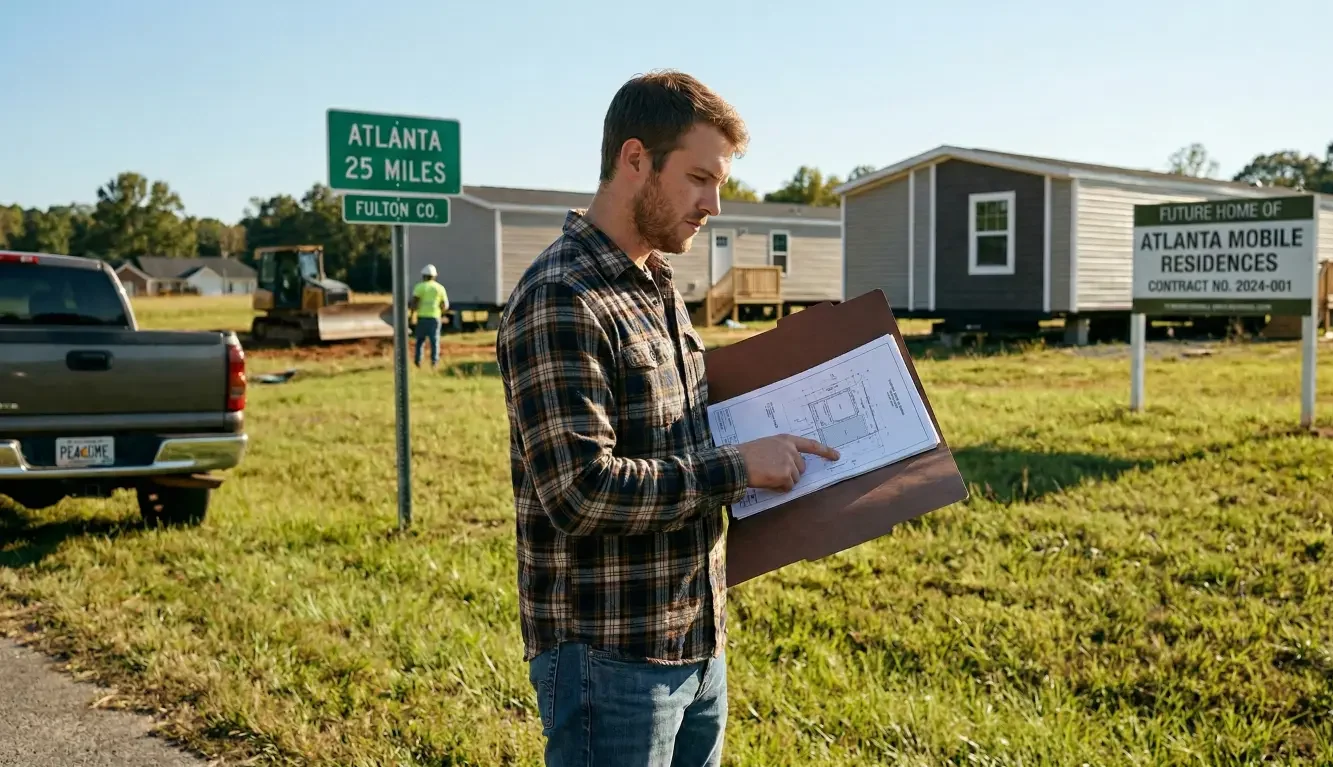
Land can look perfect on a listing—and still be a dead end for a manufactured home. The issue isn’t always the home; it’s the rules and site realities: setbacks, zoning use limits, driveway/access requirements, utilities, drainage, and what the county wants on paper. If you’re trying to move fast while shopping for land in Georgia, these manufactured home placement zoning questions can help you confirm what’s possible before you commit—so you don’t discover deal-breakers after closing.
Why “this land is perfect” can still be wrong for manufactured home placement
When buyers run into trouble, it’s usually because they only checked one side of the puzzle.
One side is the “rules” side: zoning district, allowed uses, setbacks, and any overlays or easements that limit where a home can sit. The other side is the “reality” side: whether a mover/installer can physically access the site, whether utilities are actually workable, and whether drainage or grading requirements change the placement plan.
The costly mistake is assuming approval instead of verifying it. A listing can say “mobile homes OK,” a neighbor can say “people do it out here,” or a realtor can say “it should be fine”—and the county may still have requirements or constraints that change everything. Rules can vary locally, and a quick confirmation in writing can prevent the most painful kind of surprise: buying land you can’t use the way you intended.
There are some manufactured home placement zoning questions to ask…
The pre-purchase checklist: what to confirm before you make an offer
Use this as a quick run-through on every parcel you’re seriously considering. You’re not trying to become a zoning expert—you’re trying to avoid obvious dead ends.
Zoning district and allowed residential uses (are manufactured homes allowed?)
Start by asking: “What is the zoning district for this parcel, and is a manufactured home permitted as a residential use?”
If the answer is “yes,” follow with: “Is it permitted by-right, or does it require a special/conditional approval process?” Those two paths can look very different in timeline and documentation.
Setbacks (front/side/rear) and overlays/easements that affect buildable area
Setbacks are the required distances between a structure and property lines (front, sides, and rear). Even when a parcel is large, setbacks and easements can shrink the practical “buildable area”—the portion of the lot where a home can actually be placed.
Ask for the setback requirements for that zoning district, and ask whether there are any known overlays (for example, flood-related constraints) or easements that commonly affect placement on that parcel type. If the parcel has an irregular shape, setbacks can bite harder than you expect.
Minimum driveway/access requirements (for moving a home)
Even if zoning is fine, access can be the real gatekeeper. A manufactured home move involves equipment, clearance needs, and a route that has to work in real life, not just on Google Maps.
Ask what the county expects for driveway/access (if they have requirements), and separately ask yourself whether the current access looks feasible for a move: tight turns, steep slopes, soft ground, low-hanging branches, overhead wires, narrow gates, and limited staging space can all change feasibility.
Utilities: water/sewer vs septic, power availability, permits triggered
“Utilities available” can mean many things. Ask:
- Is public water available at the road, or is a well required?
- Is public sewer available, or is septic required?
- What permits or approvals are typically triggered for well/septic and for electrical connection?
You’re not looking for a guarantee—just a clear picture of what’s required so you’re not building a plan on assumptions.
Floodplain/drainage grading implications (set height, under-home conditions)
Drainage and elevation needs can affect placement planning. If a parcel has drainage challenges or flood-related grading requirements, it can change how high the home needs to sit and what under-home conditions look like over time.
Ask whether the parcel is in a mapped floodplain or has known drainage constraints. If you don’t know, ask what office or resource can confirm it for that parcel.
Permit workflow + typical required documents (county-specific)
Counties often have a process for placement and related site work, but details vary. Ask:
- What permits are required to place a manufactured home on this parcel?
- What documents do you require to start the process?
- Is there a checklist you can share?
If a county can provide a written checklist (even a simple email outline), that’s a strong early signal you’re dealing with clarity instead of guesswork.
Zoning basics in plain English: what to ask (without pretending to be the county)
Zoning can feel like a foreign language, but you don’t need to decode everything. You need the county to answer a few specific questions clearly.
A helpful mental model is: “Is this allowed, and if it’s allowed, what conditions apply?”
- Allowed use generally means the zoning district permits that type of residence.
- Conditional or special approval may mean the use is possible, but only if certain conditions are met or a review process is completed.
You don’t need to argue terminology. Just ask the county which bucket your plan falls into and what that implies.
Here’s the misconception that trips up many buyers: “Rural” doesn’t automatically mean “anything goes.” Rural parcels can still have rules, and some areas have additional siting expectations that are easy to miss until you’re under contract.
Copy/paste county email script (use placeholders)
Subject: Manufactured home placement questions — Parcel [PARCEL ID] / [ADDRESS OR DESCRIPTION]
Hello [Planning/Zoning Office Name],
I’m considering purchasing parcel [PARCEL ID] located at/near [ADDRESS OR ROAD]. I plan to place a manufactured home on the property and want to confirm requirements before making an offer.
Could you please confirm the following in writing (email response is fine):
- What is the zoning district for this parcel?
- Is a manufactured home permitted as a residential use in this district? If yes, is it permitted by-right or does it require conditional/special approval?
- What are the front/side/rear setback requirements for a residence on this parcel?
- Are there any overlays, easements, or other known constraints that commonly affect buildable area or placement on parcels like this?
- What permits are typically required to place a manufactured home on this parcel, and do you have a checklist of required documents?
- Is there anything else you recommend I confirm before purchasing land for a manufactured home in this area?
Thank you,
[YOUR NAME]
[PHONE NUMBER]
The goal is not to get them to “approve” your plan. It’s to get a clear “here’s what applies” response you can keep in your file.
Setbacks and the buildable area trap: where buyers get surprised
Setbacks are simple in concept and tricky in practice. On paper, a parcel can look like it has plenty of room. In reality, the buildable area can shrink fast when you combine:
- required front/side/rear setbacks,
- easements (for utilities, access, or drainage),
- irregular lot shapes,
- and site features that limit where a home can practically sit.
This is why “it fits on the map” can still fail on placement and access. A home might “fit” in the remaining buildable area, but the route to get it there might not.
What to ask the county:
- Can you confirm setback requirements for this parcel’s zoning district?
- Is there anything unusual about placement/siting for manufactured homes in this area? (TBD county-specific)
- Is a survey recommended or required before placement permits are issued?
What to ask yourself (from the listing and a site visit):
- Where would the driveway enter, and can equipment turn and stage?
- Are there steep slopes, ditches, or soft areas near the likely placement spot?
- Are there visible easement markers, utility poles, or drainage features that reduce practical placement options?
If anything feels uncertain, it’s often worth slowing down long enough to clarify buildable area and access—before you fall in love with the land.
Permits and documentation: what counties often ask for (and why it matters early)
Permits are not usually one single “yes/no” document. They’re a process—often connected to placement, site work, and utility connections.
Details vary by county, but many counties request basic site and utility details as part of the process. The point of asking early is not to gather every form immediately. It’s to confirm you can realistically provide what they need without reinventing the wheel.
Documents buyers should expect to provide can include items like:
- a basic site plan showing where the home will sit (TBD specifics by county),
- driveway/access information or a sketch (TBD),
- septic/well information if applicable (TBD),
- and basic home details (TBD).
A common failure mode is buying land without a path to documentation. That happens when a buyer assumes the county will “tell them what to do later,” but later is when the timeline is tight and the seller expects the deal to close.
A better approach is to ask the county for their typical checklist up front and keep that with your parcel notes. Even if you don’t complete every step immediately, you’ll know what you’re signing up for.
“Can a mover/installer actually get the home in?” Access questions that affect feasibility
If you remember one contrarian idea from this article, make it this: access can be the real deal-breaker even if zoning is fine.
Access issues can show up in several ways:
- Driveway width and alignment: Narrow entries or tight gates can limit equipment.
- Slope and traction: Steep or soft access can become a safety and feasibility issue.
- Turn radius and staging: The route may require space to swing and stage.
- Overhead clearance: Branches and overhead lines can complicate movement.
- Soft ground and drainage: Equipment needs stable ground; mud and waterlogged areas can change what’s feasible.
A listing photo rarely tells the full access story. When you’re serious about a parcel, try to do a quick on-site look (even if it’s informal) and take photos from the road entrance, the driveway path, and the likely placement area.
When to request a site look instead of guessing:
- the driveway is long, narrow, steep, or unmaintained,
- the parcel is heavily wooded near the access route,
- there’s a visible ditch, culvert, or drainage crossing,
- or the only viable placement spot is far from the road with limited turning space.
Access doesn’t always mean “no.” It means “confirm the plan” before you commit.
Rural land specifics in Georgia: what tends to come up (verify locally)
Rural parcels can be great for manufactured homes, but rural also tends to surface a different set of practical questions. These are general considerations to verify locally, not one-size-fits-all rules.
Well/septic considerations and placement planning
If a parcel will rely on well and septic, it can influence where a home can sit and how site work is planned. You don’t need to engineer the system yourself, but you do want clarity on whether septic is allowed, what office handles it, and what the process looks like.
A good county question is: “If this parcel uses septic, what approvals or documentation should I expect before placement?”
Addressing/911, right-of-way, and utility extension realities
Some rural parcels involve longer utility runs, unclear right-of-way situations, or delays for bringing services to the site. Even if the home is allowed, utilities can still shape timeline and cost.
A practical question to ask: “Is power available at the road, and is there anything I should know about connecting service to a residence on this parcel?”
How to phrase questions so the county can answer clearly
Counties can answer faster when your question is specific and parcel-tied. Use:
- parcel ID,
- road name and nearby intersection,
- and a simple statement of intent (“place a manufactured home as a residence”).
Avoid broad hypotheticals. Ask what applies to that parcel and that use.
Proof posture: how to get confidence without “guarantees”
When you’re shopping for land, you’re not trying to eliminate every unknown. You’re trying to remove the “obvious surprises.”
A simple way to do that is to build an “approval packet” for each serious parcel. It can be one folder per parcel with:
- the parcel ID and listing link,
- screenshots or notes of the zoning district,
- county email responses (especially about allowed use and setbacks),
- maps or references the county points you to,
- your site photos (road entrance, driveway path, likely placement area),
- and notes about utilities and drainage observations.
Written confirmation helps prevent miscommunication. When you’re under contract, it’s easy for details to blur across phone calls and different offices. Saving what you learned in writing keeps you grounded in facts.
When to pause the deal and get a site evaluation or installer input:
- zoning is conditional or unclear,
- setbacks/easements appear to compress buildable area,
- access looks tight, steep, or soft,
- utilities are not straightforward,
- or drainage/elevation constraints suggest special planning.
You don’t need guarantees. You need enough clarity to make a confident purchase decision.
Next steps: use this checklist on every parcel before you fall in love with the land
Here’s a simple decision logic you can run repeatedly while you shop:
- Verify the rules (zoning and allowed use).
- Verify the siting constraints (setbacks, easements, buildable area).
- Verify access (can a move and placement plan realistically work?).
- Verify utilities and drainage realities.
- Then negotiate with eyes open.
If you do those steps in that order, you dramatically reduce the odds of buying a lot that looks great but can’t accept the home.
CTA content
If you’re shopping for land, don’t wait until after you buy to learn the deal-breakers.
Send us the parcel listing, any photos, and the county info you’ve received (even screenshots).
We’ll help you think through access, site readiness, and the right questions to ask so you can choose land that can actually accept the home.
Call or request a feasibility review—scope-first, no pressure.
FAQ content
1) What questions should I ask the county before placing a manufactured home?
Ask the parcel’s zoning district, whether manufactured homes are permitted as a residential use, whether approval is by-right or conditional, what setbacks apply, what permits are required, and what documents the county wants to start the process. Request the answers in writing when possible.
2) What are common setbacks for manufactured homes in Georgia counties?
Setbacks vary by county, zoning district, and sometimes by subdivision rules or overlays. The best approach is to ask your county planning/zoning office for the front/side/rear setback requirements for the specific parcel you’re considering.
3) What permits are needed to place a manufactured home on land?
Many counties require permits or approvals tied to placement and related site work and utility connections, but the exact list varies. Ask the county what permits apply to your parcel and request a checklist of required documents so you can plan ahead.
4) Can I place a manufactured home on rural land in Georgia?
Sometimes yes, but “rural” doesn’t automatically mean manufactured homes are allowed everywhere. Zoning and local rules still apply, so confirm the parcel’s zoning district, allowed uses, and any siting constraints directly with the county.
5) What should be in a manufactured home placement approval checklist?
A good checklist includes: zoning/allowed use confirmation, setback requirements, known easements/overlays affecting buildable area, permit workflow and required documents, utility feasibility (water/sewer vs well/septic, power), and access feasibility for moving and placing the home.
6) What access requirements matter when moving a manufactured home onto a property?
Key access considerations include driveway width and slope, turning space and staging area, ground firmness (soft ground can change feasibility), overhead clearance (trees and lines), and any tight gates or drainage crossings. If access looks uncertain, on-site photos and an installer/mover’s input can prevent surprises.
Request a placement feasibility review (share parcel listing + photos + county info you’ve received)
Schedule a quick call to map zoning questions, access risks, and the placement checklist