
“Permanent foundation” sounds like one of those phrases that should settle a question quickly. In a live manufactured home loan file, it usually does the opposite.
An underwriter adds a condition. The borrower asks the retailer what it means. The installer says the home is already set. Someone else says it is “on blocks,” so it should be fine. Then a request goes out for a “foundation cert,” even though no one has stopped to clarify whether the issue is the actual site setup, the documentation in the file, the wording of the condition, or some combination of all three.
That is why this topic creates so much friction. In manufactured housing, permanent foundation manufactured home lender questions often are not just about construction.
They are also about interpretation, proof, and timing. When different people in the transaction use the same phrase to mean different things, the file slows down and the risk of ordering the wrong next step goes up.
The most useful way to approach this is not to ask for a shortcut answer like “can this be financed?” The better question is: what exactly is the lender trying to verify, and what is the most efficient way to prove or correct it?
Why “Permanent Foundation” Creates So Much Confusion in Manufactured Home Loans
The confusion starts because the phrase feels more precise than it often is in practice.
To an underwriter, “permanent foundation” may signal that the file needs a clearer basis for collateral acceptability, documentation, or program fit. To a borrower, it may sound like a simple yes-or-no construction issue. To an installer, it may raise questions about the actual setup at the site. To an appraiser or processor, it may show up as a condition that needs clarification before the loan can move forward.
All of those perspectives are understandable. The problem is that they do not always line up.
A manufactured home transaction can stall because one party is talking about physical support under the home, another is talking about required documentation, and another is talking about loan-program expectations. Everyone may be discussing the same property, but not the same issue.
This is why “permanent foundation” often becomes a workflow problem rather than a vocabulary problem. The file moves forward only when the team identifies which part of the issue they are actually dealing with. Is the site setup incomplete? Is the setup potentially acceptable but poorly documented? Or is the lender condition too broad and in need of clarification before anyone orders work or paperwork?
That is the real source of confusion. The term feels singular, but the problem usually is not.
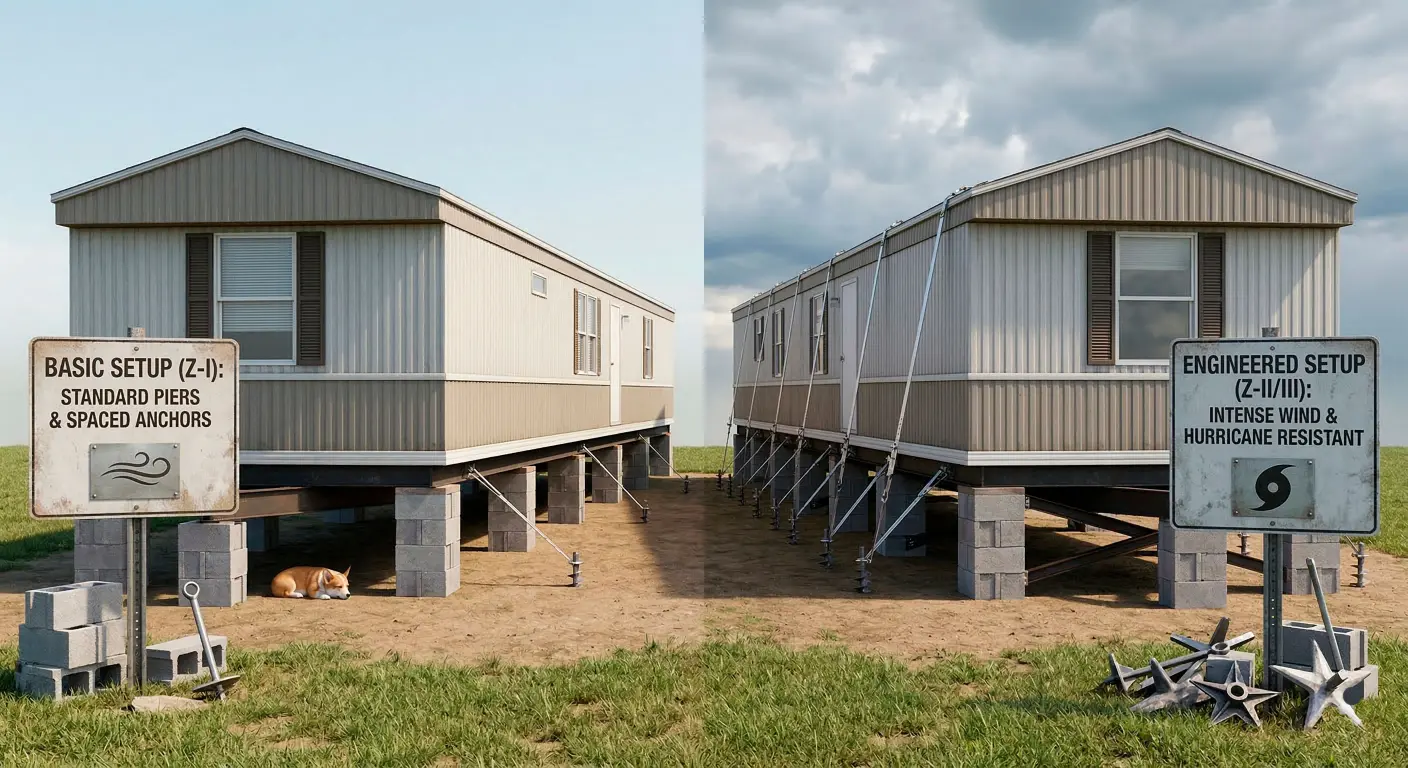
Standard Setup vs Permanent Foundation: The Distinction Lenders Care About
When people compare standard setup to a permanent foundation, they often picture two totally different-looking homes. That can be misleading. The distinction lenders care about is not always obvious from a quick visual glance, and it is rarely smart to reduce the issue to one simplistic question like whether the home is “just on piers.”
What people often mean by “standard setup”
In everyday conversation, a standard setup usually refers to the practical installation work that gets a manufactured home placed, leveled, supported, anchored, and ready for occupancy or inspection. People may think in terms of blocking, piers, tie-downs, skirting, utility hookups, and final stabilization.
That framing makes sense from an installation standpoint. It describes what people can see and what they understand as “the home is set.”
But a standard setup description is not always enough for underwriting purposes. A home can look complete from the borrower’s point of view and still leave open questions in the loan file about how the setup should be categorized, documented, or evaluated.
What “permanent foundation” usually signals in a loan file
In a loan file, “permanent foundation” often signals that the lender wants more than a general statement that the home is installed. It may mean the file needs a clearer demonstration of how the home is supported, whether the setup aligns with the loan context, and what documentation backs that conclusion.
That does not automatically mean the property is defective. It also does not automatically mean immediate construction changes are required. Sometimes the issue is indeed the physical setup. Other times, the issue is that the file contains broad language, incomplete records, or mismatched expectations between the parties.
This is why some lenders and loan programs may treat permanent foundation as a distinct requirement rather than a casual synonym for “the home is already sitting there.” The phrase often carries underwriting meaning, not just field-language meaning.
Why visual appearance alone does not answer the question
A borrower may walk around the property and see piers, supports, and an apparently stable home. An installer may say the site looks solid. Even so, visual appearance alone rarely resolves the lender’s concern.
That is because underwriting decisions generally depend on how the setup is characterized and documented, not just how it looks from the outside. Two homes can appear similar to a non-specialist and still produce different lender questions depending on the records, the appraiser’s comments, the program, or the exact wording of the file condition.
This is the point many transactions miss. The issue is not simply “Does the house look permanent?” The issue is whether the home’s setup and the file documentation together answer the lender’s actual concern.
The First Decision to Make: Is This a Site Problem, a Documentation Problem, or a Wording Problem?
Before anyone orders repairs, inspections, or letters, the first decision should be diagnostic.
The team needs to decide whether the problem is primarily at the site, in the file, or in the language being used. That sounds simple, but it can prevent a lot of avoidable rework.
A site problem means there is a real question about the physical setup under the home. Perhaps the support system is incomplete. Perhaps the anchoring or under-home conditions raise legitimate concern. Perhaps the installation no longer matches what the lender or appraiser expects to see.
A documentation problem means the physical setup may or may not be adequate, but the file does not currently contain the right proof to show that clearly. Photos may be missing. Records may be outdated. Prior work may have been done, but the transaction team cannot verify it in a way that satisfies the current file.
A wording problem means the condition itself may be too broad or too loosely interpreted. For example, one party may hear “permanent foundation” and assume that an engineer certification is automatically required, while the actual file issue may be narrower and depend on clarifying the lender’s exact request.
This triage matters because each problem type leads to a different next step. If it is a site problem, field review and possible correction may be needed. If it is a documentation problem, the fastest answer may come from collecting the right records rather than ordering new construction. If it is a wording problem, the first move may be clarification back through the loan process before anyone spends money or time.
Without this first decision, transactions tend to drift into guesswork.
A Contrarian but Useful Truth: Not Every “Permanent Foundation” Condition Starts With Construction
This is the point that surprises many people in manufactured home lending.
When an underwriter requests “permanent foundation,” the reflex is often to jump immediately to site work. People assume the property must be changed before the file can proceed. Sometimes that is true. But not every permanent foundation condition starts with construction.
In many cases, the more immediate problem is that no one has translated the lender’s language into an actionable scope. The borrower hears a phrase. The retailer repeats it. The installer gets a vague request. The engineer, if involved, may be asked for a document that does not match the actual file need. By the time everyone realizes the issue was not framed correctly, time has already been lost.
That is why a useful contrarian mindset is this: do not begin with the assumption that the site is wrong. Begin with the assumption that the file needs interpretation.
The goal is not to deny that site corrections may be needed. The goal is to avoid treating every condition as a construction order before understanding the issue behind it.
For example, if the appraiser comments on the under-home condition in a way that raises questions, the right first step may be to review those comments closely and compare them with current photos and installation details. If the underwriter adds broad “permanent foundation” language, the right first step may be to determine whether the concern is program-specific, document-specific, or tied to an observed site feature.
This is often where transactions recover momentum. Once the condition is translated into a real question, the next step gets much clearer.
Where Transactions Go Wrong
Manufactured home loan files rarely blow up because one person made a dramatic mistake. More often, they stall because several small assumptions stack on top of each other.
One common error is requesting a generic “foundation cert” too early. This happens when the team hears lender language and immediately asks for a document without clarifying what issue the document is supposed to resolve. If the condition was misunderstood, the wrong document may be ordered, the wrong professional may be involved, and the file may still come back with unresolved questions.
Another mistake is assuming piers and blocks automatically fail lender expectations. That kind of blanket thinking usually creates more confusion than clarity. A typical setup and a lender-acceptable permanent foundation are not always treated as the same thing, but that does not mean every home with visible piers automatically fails. The right question is not “Are there piers?” It is “How is this setup being evaluated in this loan context, and what proof is missing?”
A third problem is treating installer language and lender language as interchangeable. Installers speak in terms of site work, access, leveling, anchoring, and corrections. Lenders speak in terms of file conditions, collateral standards, documentation, and program fit. Both perspectives matter, but they are not the same. Trouble starts when the transaction team assumes one answer automatically resolves the other.
A fourth issue is delay. Sometimes everyone knows there is a question, but no one wants to slow the file down by clarifying it early. The result is the opposite of what they intended. The file moves forward with ambiguity until late underwriting, and then the missing clarity becomes harder and more expensive to fix.
When people say manufactured home deals are “complicated,” this is often what they mean. Not mysterious technical complexity, but preventable workflow confusion.
What Underwriters and Transaction Teams Usually Need to Verify
Once the team stops guessing, the next step is practical verification. The most useful reviews usually focus on three buckets: the existing setup, the current file documentation, and the right professional to involve next.
Existing setup details
The first bucket is the site itself. What is actually under the home? How is it supported? What does the current installation appear to consist of? Are there obvious issues, incomplete elements, or signs that the setup and the file description do not match?
This does not mean every underwriter needs to interpret field conditions personally. It means the team should stop relying on vague summaries like “it’s already set” or “it’s on blocks.” Those phrases do not provide enough clarity to make good decisions.
Useful setup information often includes clear under-home photos, visible support conditions, evidence of anchoring or stabilization components where relevant, and a straightforward description of what work has or has not been done. The goal is not to write an engineering report. It is to replace vague assumptions with inspectable facts.
What documentation is already in the file
The second bucket is existing documentation. Before requesting anything new, it is worth asking: what is already in the file that might answer part of this question?
There may be appraiser comments, prior installation records, contractor notes, property photos, invoices for setup work, or prior evaluations that help clarify what has been done. Sometimes the file has partial proof but not organized proof. Sometimes the documentation exists but uses inconsistent language. Sometimes the key issue is simply that no one has matched the documents to the lender’s exact condition.
This is where teams often save time. If the needed answer is partly already there, the smartest move may be to gather and interpret what exists before commissioning more work.
Whether a professional engineer, installer, or inspector is the right next party
The third bucket is role clarity.
In some scenarios, an installer is the right first contact because the real issue is site condition or setup scope. In some cases, an inspector may help clarify what is present at the property. In other cases, a professional engineer may become part of the process, especially when the lender or program context calls for a more formal level of verification.
The mistake is assuming one professional solves every version of the problem. An engineer is not always the first step. An installer is not always the last word. An inspector is not always enough. The right next party depends on what kind of problem the file actually has.
That is why sequencing matters so much. When the wrong person is asked the wrong question, the transaction loses days and sometimes weeks.
A Practical Review Path When the Underwriter Requests “Permanent Foundation”
When an underwriter requests “permanent foundation,” the fastest path is usually a structured review rather than a hurried reaction.
Start with the exact wording of the condition. Not the summary someone repeated by phone. Not the interpretation passed through three people. The actual wording. That language often contains clues about whether the issue is broad, document-specific, or tied to a particular concern in the file.
Next, compare that wording against what is already known about the property. What do the current photos show? What installation records exist? Has anyone documented the setup in a way that helps answer the condition directly?
Then identify whether the likely gap is physical, documentary, or interpretive. If it looks like a site issue, that points toward field review and possible corrective scope. If it looks like a documentation issue, the next step may be collecting better records or aligning existing records to the file requirement. If it looks like an interpretation issue, it may be wise to clarify the requirement before anyone orders a certification or schedules construction.
After that, choose the next party deliberately. Ask the installer about setup scope, not underwriting conclusions. Ask the engineer for the specific type of review relevant to the clarified issue, not a vague catch-all letter. Ask for additional inspection or site review only when it will answer an actual unanswered question.
Finally, communicate in specific language. “The underwriter wants a permanent foundation” is usually too vague to move a file well. “The file needs clarification on whether the current setup and supporting documentation meet the lender’s permanent foundation condition” is much more actionable. The more precise the language, the lower the chance of duplicated work.
This process may feel slower in the first hour, but it is often much faster over the life of the file.
What Evidence Helps Move the File Forward
When a manufactured home file is stuck on permanent foundation questions, progress usually comes from evidence, not opinion.
Clear property photos help because they reduce ambiguity about what is actually present. Current under-home images can be especially useful when the file is relying too heavily on assumptions or secondhand descriptions.
Installation details matter because they help distinguish a completed setup from a partially understood one. Even basic records can be useful if they show what work was done, when it was done, and by whom.
Prior records help because they can show whether the home has already been evaluated, corrected, or documented in a way that speaks to the current file. That does not mean old paperwork automatically resolves today’s lender concern, but it can help shape the next step intelligently.
The exact wording of the lender condition matters because it defines the problem the team is trying to solve. Without that wording, everyone tends to substitute their own guess.
And if corrective work is needed, a clear scope matters just as much as the work itself. A vague statement that “foundation work was done” may not move the file very far. A more specific description of what was reviewed or corrected is often more useful.
If a manufactured home loan is stalled over a “permanent foundation” condition, the next step should be clarity—not guessing.
We help homeowners and transaction teams review setup conditions, identify what may need correction, and align the work to the actual request.
Call Superior Mobile Home Setup or request a quote to discuss the property and documentation path.
When to Call for Site Review Instead of Guessing
There comes a point in some files where more debate stops being productive.
If the borrower is getting conflicting answers, if the underwriter condition remains too abstract, if current photos are incomplete, or if the transaction team still cannot tell whether the issue is physical or documentary, a site review may be the most efficient next step.
That is especially true when the property is close to closing and the cost of continued ambiguity is higher than the cost of a focused evaluation. A clear site review can help the team stop recycling opinions and start working from facts.
This is also the right move when the phrase “permanent foundation” has already triggered a chain of half-steps: a vague request to the installer, a broad guess from someone on the transaction team, and a stalled file with no clean answer. At that stage, guessing is usually more expensive than reviewing.
The practical goal is not to make the process more formal than it needs to be. It is to prevent the common pattern where everyone keeps moving, but the file itself does not.
For underwriters, processors, borrowers, retailers, and installers alike, the key lesson is the same: permanent foundation questions become manageable once the team stops treating the phrase as self-explanatory. In real manufactured home transactions, the issue often sits at the intersection of site conditions, file documentation, and lender interpretation. The sooner that is recognized, the easier it becomes to take the right next step.
FAQ Content
What is a permanent foundation for a manufactured home?
In lending conversations, a permanent foundation for a manufactured home usually refers to more than the home simply being placed and supported. It often signals that the lender wants the setup and documentation reviewed in a way that fits the loan file’s requirements.
What does it mean when a lender requires permanent foundation?
It usually means the file needs clearer proof or evaluation related to how the manufactured home is installed. Depending on the loan context, the issue may involve the physical setup, the documentation in the file, or the exact interpretation of the lender’s condition.
What is the difference between piers and a permanent foundation for a manufactured home?
Piers describe part of a support method that may be visible under the home. A permanent foundation question in underwriting is broader. It often involves how the setup is categorized and documented, not just whether piers are present.
Can a manufactured home on blocks be financed?
Sometimes the answer depends on the loan program, the lender’s standards, the condition of the setup, and the supporting documentation in the file. A visible block-and-pier style setup alone does not answer the financing question by itself.
Does an underwriter always need an engineer letter for permanent foundation?
Not always. In some scenarios, a professional engineer may be part of the verification process, but the right next step depends on the actual file condition and what is missing. It is better to clarify that first than to assume an engineer letter is automatically required.
What documents help verify a manufactured home permanent foundation condition?
Helpful documents may include current property photos, under-home photos, installation records, contractor information, prior evaluations, and the exact wording of the lender condition. The best document set depends on whether the issue is physical, documentary, or both.
If a manufactured home loan is stalled over a “permanent foundation” condition, the next step should be clarity—not guessing.
We help homeowners and transaction teams review setup conditions, identify what may need correction, and align the work to the actual request.
Call Superior Mobile Home Setup or request a quote to discuss the property and documentation path.
RELATED LINKS: