
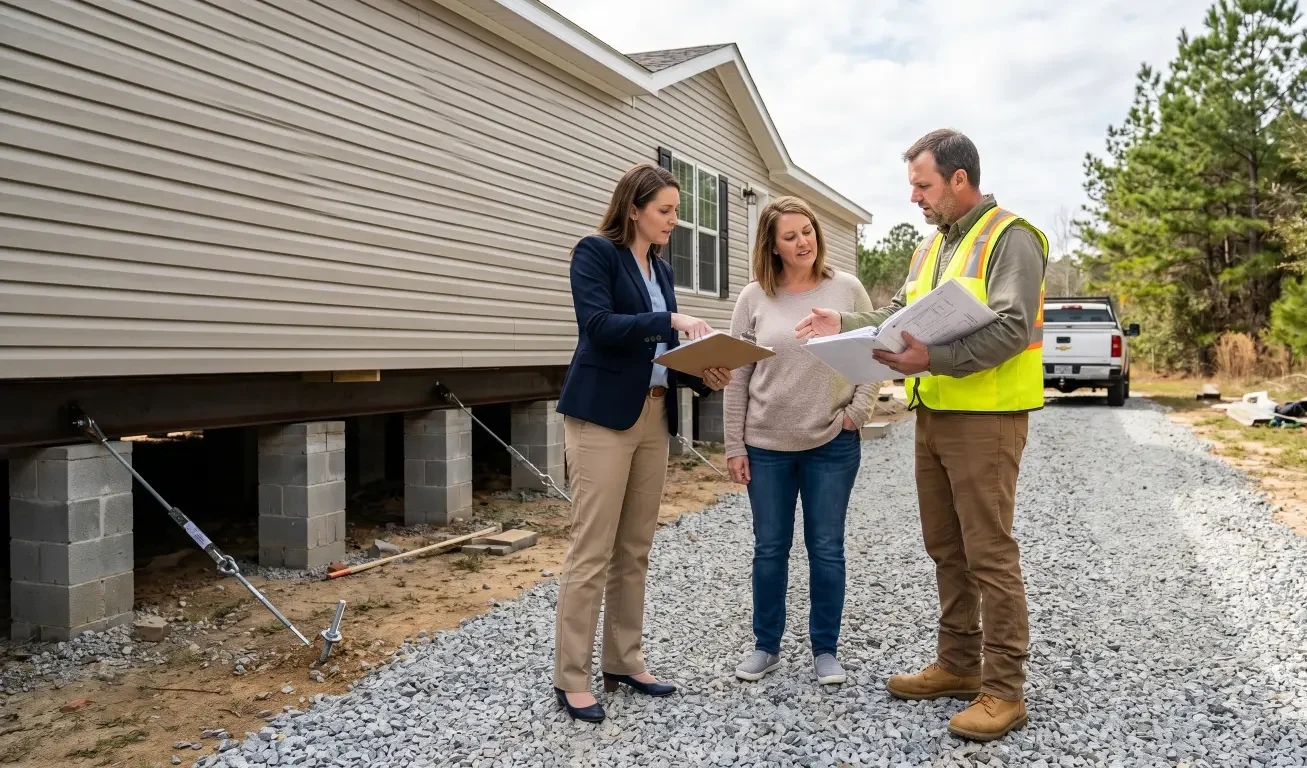
FHA manufactured home foundation requirements can create confusion fast. A loan officer may see a condition in the file that says the manufactured home needs a permanent foundation, foundation certification, anchoring verification, or evidence that the home meets HUD/FHA requirements. The buyer may hear that and ask a contractor to “certify the foundation.” The installer may need more detail before quoting the work. The engineer or inspector may be needed for a specific document. Meanwhile, the closing timeline keeps moving.
The most important thing to understand is that FHA foundation requirements are not solved by guessing. They are solved by identifying the exact condition language, understanding what FHA and the lender are asking for, correcting any setup or anchoring issues that apply, and producing the right documentation for review.
This guide explains FHA manufactured home foundation requirements in practical terms for loan officers, buyers, and transaction stakeholders. It covers what FHA generally cares about, why “foundation certification” is often misunderstood, what documentation may be needed, and how to avoid sending the homeowner or contractor down the wrong path.
Start With the Exact Loan Condition
When a manufactured home file receives a foundation-related condition, the first step is to read the exact wording. Do not summarize it too quickly. Do not reduce it to “they need a certification” unless the file clearly says what type of certification, who must provide it, and what standard must be met.
The condition may refer to a permanent foundation, anchoring, tie-downs, piers, skirting, additions, site drainage, engineer certification, HUD Permanent Foundations Guide requirements, or documentation that confirms the home is properly installed. Those are not all the same request.
For a loan officer, the cleanest workflow is to copy the condition language exactly and share it with the appropriate parties. That may include the borrower, setup contractor, inspector, professional engineer, or underwriter. Exact wording reduces the risk of ordering the wrong inspection, quoting the wrong repairs, or producing a document the lender cannot use.
What FHA Cares About in Plain Language
FHA is concerned with whether the manufactured home is real property, properly installed, and supported by a foundation system that meets applicable standards for the loan program and property type. In practical terms, this often means the home must be attached to a permanent foundation, properly anchored, stable, and acceptable for the lender’s review.
The review may consider whether the home is supported correctly, whether the foundation components are suitable, whether the anchoring system is adequate, whether additions or site conditions create concerns, and whether the documentation matches the lender’s requirements.
That does not mean every file requires the same contractor scope. One home may need missing tie-downs corrected. Another may need pier or footing work. Another may need an engineer’s certification after evaluation. Another may need documentation that confirms previous work was completed. The condition language and property facts drive the next step.
The Common Misread: “Just Certify It”
One of the most common mistakes is treating FHA foundation certification as a simple signature. In reality, foundation certification is usually a workflow, not a single piece of paper that anyone can produce on request.
A qualified party may need to evaluate the home, identify whether the foundation and anchoring meet the required standard, recommend corrections if needed, confirm those corrections were completed, and then provide documentation that the lender will accept. Depending on the file, a professional engineer may need to be involved.
A setup contractor may be able to complete physical corrections such as anchoring, leveling, support adjustments, or foundation-related work. But that does not automatically mean the contractor is the right party to issue every type of certification. The lender’s condition determines what is required.
Loan officers can prevent delays by asking: What exact document does underwriting need? Who is allowed to provide it? Does the property need repairs before that document can be issued? Is a professional engineer required? Are photos, invoices, or completion notes also needed?
Permanent Foundation Does Not Always Mean the Same Scope
The phrase permanent foundation can be confusing because people use it casually. A borrower may think it means the home is simply sitting on blocks and tied down. A lender may mean compliance with a specific FHA/HUD-recognized standard. A contractor may need to know whether the request involves piers, footings, anchors, perimeter enclosure, additions, or corrections to previous installation work.
Before quoting work, the contractor needs the actual requirement. Without that, the homeowner may pay for a correction that does not satisfy the loan condition.
For example, adding anchors may help if the problem is missing tie-downs. But if the condition requires an engineer’s certification for the foundation system, anchoring work alone may not produce the needed document. Likewise, a visual inspection may identify obvious setup issues, but a lender may still require a specific engineering letter.
FHA Permanent Foundation Manufactured Home Checklist Mindset
Loan officers often want a simple FHA permanent foundation manufactured home checklist. A checklist can help, but it should not replace the lender’s actual condition or professional evaluation.
A practical checklist mindset includes these questions:
Is the home classified and titled in the way the loan program requires? Is the foundation intended to be permanent? Are piers, footings, supports, and anchors present and properly installed? Are there signs of settling, movement, or missing components? Is the home level and stable? Are additions or decks attached in a way that affects the home? Is drainage causing erosion or support concerns? Does the lender require an engineer’s certification? Are photos, invoices, or completion documents needed?
The point of the checklist is not to make the loan officer an engineer or installer. The point is to identify gaps early so the right professional can be brought in before closing pressure creates rework.
Anchoring and Tie-Down Conditions
FHA loan conditions for manufactured home anchoring may appear when the under-home support system is incomplete, unclear, outdated, or not documented. Anchoring matters because manufactured homes must be secured against wind and movement according to applicable requirements.
If a condition mentions anchoring, tie-downs, straps, or stabilization, the next step is to determine whether the issue is physical, documentary, or both. Does the home need additional anchors installed? Are existing anchors damaged or missing? Is documentation needed to show that anchoring was corrected? Does an engineer or inspector need to verify the system?
Superior Mobile Home Setup supports setup, leveling, anchoring, and foundation-related work. That kind of physical correction may be part of solving a condition, but the file should still be checked for who must sign off after the work.
Site Conditions Can Affect Foundation Acceptability
Foundation issues are not only about blocks and anchors. Site conditions can affect whether the home remains stable. Drainage, soil, erosion, grading, and access conditions can all influence manufactured home setup.
If water flows under the home, soil can soften or wash out around supports. If the site was not prepared properly, piers may settle. If additions or decks put stress on the home, they may complicate the evaluation. If the home is not level, doors, windows, and interior finishes may show signs of movement.
A foundation-related condition may therefore require more than a document. It may require site observations and practical corrections before documentation can be issued.
Documentation Caution for Loan Officers
Documentation is where many files lose time. A loan officer may request a “foundation cert” when underwriting actually needs a professional engineer letter. A borrower may hire someone to re-level the home when the file requires documentation of permanent foundation compliance. A contractor may provide an invoice, but the lender may still need photos or an engineer’s report.
To avoid wrong FHA certification requests, build the document chain from the condition outward. Ask underwriting what document is acceptable. Ask whether the signer must be a professional engineer. Ask whether the contractor’s invoice is enough to document corrections or whether post-correction review is required. Ask whether the document must reference FHA/HUD standards or specific property conditions.
This is not about making the process more complicated. It is about avoiding the wrong deliverable.
Installer vs. Engineer vs. Inspector: Who Does What?
Different professionals may be involved in a manufactured home foundation file.
A setup or installation contractor may handle physical work such as leveling, anchoring, pier adjustments, support corrections, transport, placement, or foundation-related improvements. A professional engineer may evaluate and certify whether the foundation meets required standards when the lender requires engineering documentation. A home inspector or appraiser may observe conditions and report concerns, but they may not be the person who designs repairs or certifies compliance. The lender or underwriter decides what documentation is acceptable for the loan file.
Confusion happens when one party is asked to do another party’s job. A contractor can help complete corrections, but may not be the required signer for an engineering certification. An engineer can evaluate and certify, but may need physical corrections completed before issuing the final document.
A Better Call Script for Foundation Conditions
A loan officer can reduce confusion by using a clear call script when speaking with the borrower, contractor, or other stakeholder.
Instead of saying, “We need the foundation certified,” say: “The loan file has a foundation-related condition. Here is the exact wording. We need to determine whether this requires physical corrections, an inspection, an engineer’s certification, or a combination. Please review the condition language before quoting or scheduling work.”
If the borrower is calling a contractor, they can say: “My lender gave me this exact condition. Can you tell me which parts of the physical setup you can evaluate or correct, and whether an engineer or other professional may be required for the final documentation?”
This simple shift keeps everyone aligned to the real requirement.
Red Flags That the File Is Heading Toward Rework
Several warning signs suggest the process is drifting toward delay. One is when nobody has the exact condition language. Another is when the borrower asks for a generic certification without knowing who must issue it. Another is when a contractor quotes a repair before seeing the condition, photos, site details, or lender requirement.
Other red flags include promising FHA approval, assuming an invoice will satisfy underwriting, ignoring anchoring or site drainage, failing to clarify whether a professional engineer is required, or scheduling a final review before corrections are complete.
When these red flags appear, slow down and clarify the workflow. A few extra questions at the beginning can save days or weeks later.
How Superior Mobile Home Setup Can Help
Superior Mobile Home Setup serves Georgia homeowners, buyers, and transaction stakeholders with mobile home transport, setup, installation, leveling, anchoring, and foundation-related support. The company’s process-driven approach is useful when a loan file has a manufactured home condition that needs physical work, scope clarity, or documentation support.
Superior Mobile Home Setup does not control lender approval, underwriting decisions, or engineering requirements. What the team can do is help evaluate the setup-related scope, complete applicable physical corrections, and coordinate work around the exact condition language so the borrower and loan team are not guessing.
If a Georgia FHA loan file has a foundation, anchoring, or setup condition, call or request a quote and share the condition language before scheduling. That gives the team a clearer starting point and helps avoid wrong requests.
FHA Foundation Condition Workflow
Use this practical workflow when a manufactured home file has a foundation condition:
- Copy the exact lender or underwriting condition language.
- Identify whether the condition mentions foundation, anchoring, tie-downs, engineer certification, inspection, or corrections.
- Ask who is allowed to provide the required documentation.
- Determine whether physical corrections are needed before documentation.
- Share the condition language with the setup contractor, engineer, or inspector before scheduling.
- Complete any required setup, anchoring, leveling, or foundation-related corrections.
- Collect photos, invoices, completion notes, or engineer documentation as required.
- Submit the right documents back to the lender for review.
- Avoid promising approval until underwriting confirms acceptance.
FHA manufactured home foundation requirements are manageable when the process starts with clarity. The problem is not that foundation conditions are impossible. The problem is that they are often translated too loosely.
Do not reduce the file to “needs a cert” without knowing what the lender actually requires. Start with the condition language. Identify whether the need is physical correction, inspection, engineering documentation, or all of the above. Then bring in the right professionals in the right order.
For Georgia manufactured home buyers and loan teams, Superior Mobile Home Setup can help with the setup, anchoring, leveling, and foundation-related work that may be part of resolving the condition. Call or request a quote with the exact condition language so the scope can be built around facts, not guesses.
FAQ
What are FHA manufactured home foundation requirements?
FHA manufactured home foundation requirements generally relate to whether the home is properly installed, supported, anchored, and attached to a permanent foundation that meets the applicable loan program and lender requirements. The exact documentation needed depends on the file and underwriting condition.
What does FHA foundation certification manufactured home mean?
It usually means the lender needs documentation that the manufactured home foundation meets required standards. In many cases, that documentation may need to come from a professional engineer, especially if the condition asks for an engineering certification. Always confirm the exact requirement.
What is HUD 4000.1 manufactured home foundation guidance?
HUD Handbook 4000.1 is the FHA Single Family Housing Policy Handbook. It includes manufactured housing policy requirements used in FHA loan review. Loan teams should use current lender and HUD guidance rather than relying on informal summaries.
Can a setup contractor provide FHA foundation certification?
A setup contractor may be able to perform physical corrections such as leveling, anchoring, or foundation-related work. However, if the lender requires an engineer’s certification, a qualified professional engineer may need to inspect and provide the document. The condition language controls the answer.
How can loan officers avoid the wrong FHA certification request?
Loan officers should copy the exact condition language, confirm who must provide the document, determine whether corrections are needed first, and share the condition with the contractor or engineer before scheduling work. Avoid vague requests such as “just certify it.”
RELATED LINK:
U.S. Department of Housing and Urban Development – FHA Single Family Housing Policy Handbook 4000.1