
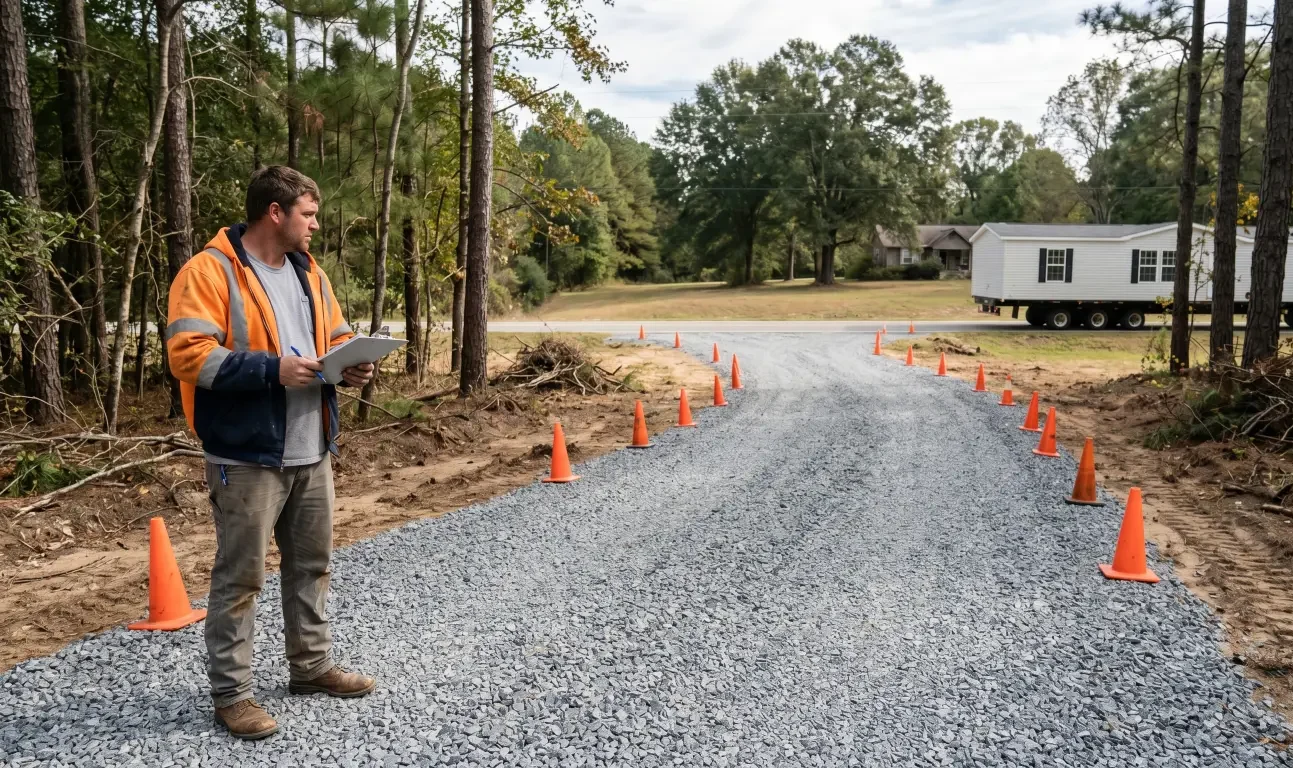
A manufactured home delivery can fail before the home ever reaches the pad. The problem is not always the home, the crew, or the schedule. Many delivery-day failures come from access issues that were visible days or weeks earlier: a driveway that is too tight, a turn that cannot be made safely, soft ground after rain, low limbs, overhead wires, steep slope, or no clean staging area.
For site prep contractors, homeowners, retailers, and project coordinators, access planning is one of the simplest ways to protect the delivery date. The goal is not to guess whether the transport crew can “probably make it.” The goal is to walk the route, document the constraints, and confirm the plan before the home is on the road.
Here is how to check driveway and access conditions before a manufactured home delivery, with the issues that most often cause delays, rescheduling, or last-minute site work.
Delivery Access Is More Than Driveway Width
When people ask about manufactured home delivery access requirements, they often start with one question: “How wide does the driveway need to be?” Width matters, but it is only one part of the access picture.
A delivery crew needs a route that works from the public road to the final placement or staging area. That route has to account for the size of the home section, the transport vehicle, the turning path, the slope, surface stability, overhead clearance, drainage, nearby structures, and where the home can safely wait while setup work continues.
A driveway can look wide enough from a pickup truck and still be a problem for a manufactured home section. The home is long, the transport equipment needs room to swing, and small obstacles can become big constraints when the load is oversized.
Start at the Public Road, Not the Home Pad
A useful access check starts before the driveway. Walk or drive the route from the nearest main road or delivery approach. Look at the roads, intersections, shoulders, culverts, ditches, mailboxes, signs, tree canopies, and any tight turns leading to the property.
The first turn off a public road is often where access problems show up. A narrow entrance, steep ditch, sharp mailbox placement, utility pole, or tight gate can prevent a clean entry even when the driveway itself looks usable.
Document the route with photos and short notes. Take wide photos of entrances and turns, not just close-ups. A hauler or setup crew needs to see the full approach, including what is across the road, where the truck can swing, and whether there is room to correct the angle.
Check Turn Radius Before Delivery Day
Turn radius is one of the biggest reasons a mobile home delivery gets delayed. A long manufactured home section does not follow the same path as a car or work truck. It needs more room before, during, and after the turn.
Common problem areas include narrow driveway entrances, tight S-curves, short aprons from the road, sharp turns around trees, and routes that require backing uphill or across soft ground. A turn may also fail because of what sits near it: fences, retaining walls, parked equipment, culverts, landscaping boulders, or drainage ditches.
The safest move is to flag every tight turn early and ask the transport team to review it. If a turn radius is questionable, the answer may be temporary clearing, widening, matting, grading, removing obstacles, changing the approach direction, or creating a better staging plan.
Look at Driveway Width, Shoulders, and Edge Support
Driveway width matters, but usable width is different from visible width. A gravel drive may look wide enough until you notice soft shoulders, steep drop-offs, a culvert edge, or trees close to the travel path.
Measure or estimate the narrowest points. Pay special attention to gates, fence openings, bridges, culverts, ditch crossings, rock borders, and areas where the driveway bends. Also look at whether the driveway edge can support the load or whether tires could sink, slide, or break off the edge.
If widening is needed, it is better to know before delivery day. Temporary widening may involve clearing brush, removing posts, adding stone, compacting shoulders, or improving the entrance apron. The right fix depends on the site, equipment, weather, and delivery plan.
Do Not Ignore Slope and Grade Changes
A steep driveway can be a serious delivery constraint. The issue is not only whether a truck can climb it. The crew also has to consider traction, braking, ground clearance, turning on grade, backing maneuvers, and whether the home section can be controlled safely.
Grade changes can also create high-center risk, where the transport equipment or home section contacts the ground at a crest, dip, or driveway transition. This is common where a driveway meets a road, crosses a ditch, drops into a low area, or rises sharply toward the home site.
If the route has a steep slope, sudden dip, or rough transition, document it and ask for review. In some cases, the site may need grading, stone, temporary ramping, matting, or an alternate access route.
Check Soft Ground, Drainage, and Weather Exposure
Soft ground can turn a manageable delivery into a stuck load. This is especially important in Georgia, where rain can quickly change a site that looked firm during planning.
Walk the route after rain if possible. Look for rutting, standing water, saturated clay, low spots, poor drainage, and areas where heavy equipment has already sunk. A grassy field, freshly graded pad, or uncompacted fill area may not be ready for transport equipment just because it looks flat.
The delivery route and staging area should be firm enough for the planned equipment. If the soil is questionable, talk with the project team about stone, compaction, matting, drainage corrections, or waiting for conditions to improve. A rushed delivery across soft ground can create damage, delays, and avoidable rework.
Clear Overhead and Side Obstacles
Access is not only about the ground. Overhead clearance can stop a delivery just as quickly as a narrow driveway.
Look for low tree limbs, power lines, service drops, communication lines, decorative arches, low signs, and canopy areas along the route. Also look at side clearance: fences, parked vehicles, HVAC equipment, propane tanks, retaining walls, porches, sheds, brush, and landscaping.
Never attempt to move or raise utility lines yourself. If overhead lines are a concern, coordinate with the proper utility provider and delivery team. Tree trimming, brush clearing, and temporary obstacle removal should be handled before the home arrives, not while the driver is waiting.
Plan the Staging Area Before the Home Arrives
Staging is where the home section can wait safely before final placement or setup steps. A good staging area is not an afterthought. It should be part of the delivery access plan.
The staging area should be large enough for the home section and transport equipment, firm enough to support the load, and positioned so the next move is practical. It should not block public roads, trap other contractors, sit in a drainage path, or force the crew into an unsafe backing maneuver.
For multi-section homes, staging becomes even more important. Each section needs a sequence. The team should know which section arrives first, where it waits, how it moves to the foundation or setup area, and how the second section will enter without being blocked.
Coordinate Site Prep, Utilities, and Foundation Timing
A delivery can be delayed even when the driveway is fine if the site is not ready. Site prep, foundation or pier work, utility planning, drainage, and final approach conditions all affect the delivery sequence.
Before delivery, confirm that the pad or setup area is accessible, the route is not blocked by materials or equipment, and any required site work has reached the correct stage. If the home is being installed as part of a lender or transaction timeline, make sure the team understands which steps must happen before documentation, inspection, or handoff.
This is where a process-driven setup company matters. Superior Mobile Home Setup focuses on transport, setup, installation, leveling, anchoring, and related site realities. Early coordination helps prevent the common problem of one crew discovering that another crew left the site inaccessible.
Use a Pre-Delivery Access Checklist
A simple checklist can prevent a costly reschedule. Before delivery day, confirm the following:
- Public road approach has been reviewed for tight turns, ditches, mailboxes, signs, and shoulder limitations.
- Driveway entrance has enough usable width and swing room for the transport plan.
- Gates, fence openings, culverts, and narrow points have been measured or reviewed.
- Tight turns have been photographed and shared with the transport or setup team.
- Steep slopes, sudden dips, and rough grade transitions have been identified.
- Soft ground, drainage problems, and weather-sensitive areas have been addressed.
- Low limbs, brush, and side obstacles have been cleared where appropriate.
- Overhead wire concerns have been flagged for the proper utility or project contact.
- Staging area is firm, accessible, and large enough for the delivery sequence.
- The final pad, foundation, or setup area is not blocked by equipment or materials.
- All decision-makers know who to call if the driver finds a problem on arrival.
The checklist is not a substitute for a professional site review, but it gives everyone a better starting point. The more clearly the constraints are documented, the easier it is to decide whether the route is ready or needs correction.
When to Ask for a Site Review
Ask for a site review when the driveway is narrow, the route includes steep grades, the ground stays wet, there are sharp turns, trees crowd the entrance, or the final placement area is difficult to visualize. You should also ask for review when the home is large, the access route is rural, the site is newly graded, or the delivery date is tied to a closing or lender condition.
A site review is especially valuable when different parties are making assumptions. The homeowner may assume the site prep contractor handled access. The contractor may assume the hauler can work around the driveway. The retailer may assume the address is reachable because trucks visit the road every day. Delivery access should be confirmed, not assumed.
What to Send the Transport or Setup Team
If you are trying to get an access answer quickly, send useful information the first time. Include the property address, home size if known, route photos, driveway entrance photos, tight turn photos, slope concerns, ground condition notes, gate measurements, and where you expect the home to be staged or placed.
Short videos can help, especially when they show the drive from the road entrance to the pad. Keep the camera wide enough to show both sides of the route. Avoid sending only close-up photos that make it impossible to understand the overall approach.
The goal is to help the team spot problems before delivery day. Good information can reduce guesswork, help plan equipment, and identify site corrections while there is still time to make them.
Final Takeaway
Failed mobile home deliveries are frustrating because they are expensive, stressful, and often preventable. Most access problems do not appear suddenly. They are built into the route: the turn is too tight, the shoulder is soft, the driveway is steep, the limbs are low, or the staging area was never planned.
The best prevention is a route-first mindset. Start at the public road, check every turn and narrow point, confirm ground conditions, clear obstacles, plan staging, and communicate the site realities before the home is on the way.
If you are preparing a manufactured home site in Georgia and are unsure whether the driveway, route, or staging area is ready, contact Superior Mobile Home Setup before delivery day. A practical review up front can save a missed delivery, a reschedule, and a lot of avoidable stress.
FAQ
What driveway width is needed for mobile home delivery?
There is no single universal driveway width because the answer depends on the home section, transport equipment, turns, shoulders, slope, and site layout. The important question is usable access, not just measured width. Confirm the route with the transport or setup team before delivery.
Can a mobile home be delivered on a steep driveway?
Sometimes, but steep driveways require careful review. Slope affects traction, braking, turning, ground clearance, and safe control of the load. If the route is steep or has sudden grade changes, have it reviewed before scheduling delivery.
What turn radius is needed for manufactured home transport?
Turn radius depends on the home size, transport equipment, entry angle, road width, shoulder conditions, and obstacles near the turn. Tight turns should be photographed and reviewed early so the team can decide whether clearing, widening, grading, or an alternate approach is needed.
Can soft ground delay a manufactured home delivery?
Yes. Soft ground, saturated soil, fresh fill, poor drainage, and muddy staging areas can delay delivery or create equipment problems. If the site gets wet after rain, address drainage, compaction, stone, or matting before the home arrives.
Where should a manufactured home be staged on delivery day?
The staging area should be firm, accessible, large enough for the home section and transport equipment, and positioned so the next move is safe. It should not block the road, sit in a drainage path, or force unnecessary backing and turning.
RELATED LINK: