
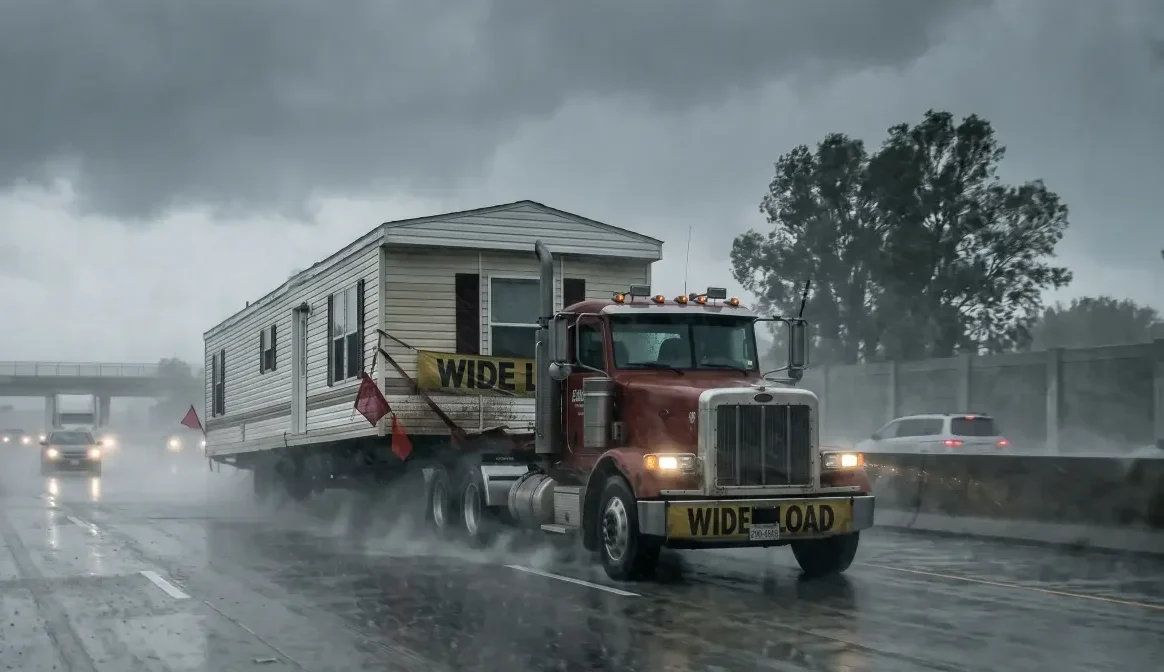
When a manufactured home move is on the calendar, people tend to organize everything around that date. Site work gets lined up. Utilities are scheduled. Family plans shift. In some cases, loan or closing timelines are built around the expected delivery window. Then the forecast changes.
Heavy rain shows up a few days before transport. Wind picks up in the outlook. The buyer starts refreshing weather apps every few hours and asking the same question in different ways: is the move still happening, or is everything about to get pushed back?
That is exactly where mobile home transport weather delays become stressful.
They do not just affect the truck on the road. They can affect permit timing, site access, crew coordination, and whether the home can be delivered safely in the first place. In Georgia, where weather can shift quickly and site conditions can change fast after a hard rain, that uncertainty is a normal part of transport planning.
The most helpful way to think about it is this: a move date is important, but safe transport and workable site conditions matter more. Weather delays are usually not a sign that someone planned badly. They are often a sign that the transport team is making the right call when conditions change.
Why Weather Matters When Moving a Manufactured Home
A manufactured home move is not like sending a small trailer down the road on a clear afternoon. These homes are typically transported as oversize loads, which means the move involves more planning, more route awareness, and more sensitivity to conditions than an ordinary delivery.
That matters because weather does not affect this kind of move in just one way.
Wind can affect the stability of large home sections while they are in transport. Rain can change the condition of the road shoulders, turn a prepared site soft, or make access points harder for heavy equipment to navigate. Even when the highway itself looks manageable, the delivery site may be the deciding factor. A truck may be able to reach the area but still be unable to place the home safely if the ground conditions are poor.
That is why transport scheduling in Georgia often includes a practical weather mindset from the beginning. It is not only about whether the home can leave point A. It is also about whether it can travel safely, arrive at the right time, and enter the site without getting stuck, damaging the property, or forcing rushed decisions at the last minute.
For buyers, this is important to understand early. A date on the schedule is never just a date. It is a moving part in a larger operation that depends on road conditions, site readiness, crew coordination, and the reality of the forecast.
The Scenario Many Buyers Face: Rain in the Forecast Before Transport Day
A common Georgia scenario goes like this.
A buyer has a delivery date set for later in the week. The pad site has been started. Maybe grading is done, or nearly done. The buyer has already spoken with utility providers, and family members are expecting progress. Then the forecast changes three or four days before transport. Instead of a mild week, it now shows steady rain or a heavy storm system right around the move window.
At first, the buyer usually thinks in simple terms: if the roads are not flooded, maybe the move can still happen. But transport teams have to think more broadly than that.
They have to consider how the weather may affect the route, visibility, site access, ground stability, timing, and safe handling of a large home section. Even if the rain looks manageable on the map, the actual site could be a very different story. In many parts of Georgia, especially on rural properties or recently disturbed land, one stretch of hard rain can turn an otherwise workable site into soft, risky ground.
This is also where emotions tend to spike. Buyers may feel pressure because other parts of the project are already in motion. They may worry that a postponement will trigger more delays with setup crews, utility scheduling, or land preparation. That stress is real, but it helps to understand that a weather-related delay is often a controlled adjustment, not a collapse of the project.
The goal is not to protect the calendar at all costs. The goal is to move the home under conditions that make the road portion and the site portion workable together.
Wind: One of the Biggest Factors in Mobile Home Transport
Buyers often think rain is the main weather concern because rain is easy to picture. They can see mud. They can imagine trucks slipping. But wind is often one of the biggest factors in manufactured home transport.
Why wind affects large manufactured home sections
A manufactured home section presents a large surface area during transport. Even without using technical freight language, the basic issue is easy to understand: the bigger the structure, the more wind can influence how it behaves on the road.
That does not mean every breezy day cancels a move. It does mean strong or unstable wind conditions can make transport less safe, especially when the load is large and route conditions already require careful handling. Gusts matter. Open stretches of highway matter. Timing matters.
For a buyer, this can feel frustrating because the day may not look “bad” in the ordinary sense. It may not even be raining. But a transport team is not asking whether the weather feels comfortable. They are asking whether the home can be moved with an appropriate safety margin.
That is an important mindset shift. A move can be delayed by weather that seems minor to someone driving a pickup truck but is much more significant for oversize load movement.
How transport teams evaluate wind conditions before moving
Most buyers want a simple yes-or-no rule, but transport decisions rarely work that way. The team usually has to look at the forecast, the route, the timing of the move, and the actual behavior of conditions as the day approaches.
This is why updates sometimes happen close to the transport date. Forecasts can change. Wind timing can shift. A day that looked workable 72 hours out may look different the evening before, and a day that seemed questionable early in the week may become workable with better conditions.
For buyers, the practical takeaway is not to demand certainty too early. It is better to build in some flexibility and expect that the final call may depend on conditions getting closer to move day. That may feel inconvenient, but it is more realistic than pretending a weather-sensitive move can be locked down the same way no matter what the forecast does.
Rain and Ground Conditions at the Delivery Site
Rain creates an obvious transport concern, but the road is only part of the issue. The site itself often determines whether delivery can actually happen.
Soft soil and heavy transport equipment
Heavy rain can soften the ground, especially on properties where site prep is recent, incomplete, or vulnerable to drainage problems. Georgia clay, graded areas, and rural access points can all react differently after a storm, but the general problem is the same: a site that looked ready a few days earlier may no longer support the equipment needed for safe delivery and placement.
This matters because transport does not end when the home reaches the property. The crew still has to get the unit into position. If the ground is too soft, that can create risk for equipment, for the home itself, and for the property. A rushed attempt to deliver anyway can leave ruts, damage the site, or force the crew into a more difficult position than necessary.
Buyers sometimes underestimate this because they focus on whether a passenger vehicle can reach the land. But the question is not whether a regular vehicle can get in and out. The question is whether heavy transport and setup-related equipment can move across the site without causing problems.
Why a clear road does not always mean the move can happen
This is one of the most important lessons for buyers to understand.
A clear road does not automatically mean a manufactured home delivery can proceed. The highway may be fine. The route may technically be open. But if the final approach to the property is muddy, narrow, unstable, or softened by rain, the move still may need to wait.
This is especially true in areas where driveways are unpaved, the land is newly prepared, or drainage is not fully under control. A site can look “almost ready” in dry weather and become a real problem after a wet day or two.
That is why transport scheduling has to connect road conditions and site conditions, not treat them as separate conversations. From the buyer’s perspective, this can feel like the goalposts moved. In reality, the whole job was always about both.
Permits and Scheduling Windows for Oversize Loads
Weather delays are not only about the forecast. They can also affect the scheduling framework around the move.
Because manufactured homes are typically moved as oversize loads, transport usually operates within permit-based and route-based planning. Even without getting too deep into state-specific rules, the important point is that these moves do not always have unlimited flexibility. Timing matters. Daylight matters. Route coordination matters. A postponed day may not automatically convert into “just go tomorrow.”
This is where buyers can get surprised. They assume the move is simply being moved from Thursday to Friday, but the actual rescheduling may depend on permit timing, crew availability, the next workable route window, and whether the site will be ready by then.
That does not mean weather delays always become major scheduling problems. Sometimes the adjustment is minor. But it does mean the transport date sits inside a larger system. When weather affects one part of that system, the new date has to fit the rest of it.
For buyers, this is why early communication matters. The sooner weather concerns are discussed realistically, the easier it is to manage expectations around what “reschedule” actually means.
A Common Misunderstanding: “If the Roads Are Clear, the Move Should Happen”
This is one of the most common misunderstandings in manufactured home transport.
Buyers often assume that if highways are open and the forecast is only showing moderate rain, the move should go forward. It sounds reasonable. But for this kind of delivery, road clearance is only one piece of the decision.
In many cases, the bigger issue is not the drive itself. It is what happens when the home gets close to the destination. Can the truck access the property safely? Can the site handle the weight and movement involved? Will the crew be forced into a rushed delivery because the conditions are deteriorating? Is wind adding risk even if visibility is still decent?
This is the contrarian truth buyers usually do not hear early enough: light rain on the road may matter less than wet ground at the site, and a day that seems “fine enough” for normal traffic may still be a poor day for mobile home transport.
That does not mean transport companies are being overly cautious. It means the job has a different risk profile than everyday hauling. If the move goes badly because the site was too soft or the conditions turned unstable, the cost of pushing ahead is usually much higher than the cost of waiting.
Typical Reasons a Transport Day Gets Postponed
When transport day gets postponed, buyers often want one clean explanation. In reality, the decision may come from several overlapping concerns.
One common reason is wind. Even if there is no severe storm, stronger wind conditions can make the move less safe than the team is willing to accept. Because the home sections are large and the transport is specialized, that can be enough to shift the schedule.
Another common reason is heavy rain affecting the site. This is especially relevant when the property includes dirt or gravel access, recent grading, soft shoulder areas, or incomplete drainage. The home may technically be ready to move, but not ready to receive.
Permit timing can also matter. If weather forces the team out of the planned window, the next workable transport slot may depend on route and scheduling constraints rather than simple availability.
And sometimes the reason is best described as an overall safety decision. Conditions may not be disastrous in any one category, but taken together they create enough uncertainty that delaying is the better call. Buyers do not always love that answer because it feels less concrete, but it is often the most honest one.
The key point is that postponement is usually not random. It is typically the result of a transport team evaluating the full move, not just one weather app screenshot.
How Buyers Can Plan for Weather Delays
Buyers cannot control the forecast, but they can reduce the stress that comes from it.
One of the smartest steps is to build buffer time into the overall schedule. If the move date is treated as the one immovable point in the whole project, any weather shift will feel like a crisis. If there is some flexibility between delivery, setup, utilities, and occupancy expectations, the project becomes easier to manage.
It also helps to think about site readiness in weather terms, not just construction terms. A site that is technically prepared in dry weather may still need better access, better drainage, or more realistic timing if rain is likely. Asking practical questions ahead of time can make a big difference. How does the property handle water? Is the driveway likely to soften? Is there a narrow or sloped approach that becomes harder after rain?
Another useful step is scheduling earlier rather than later. Buyers often ask how far in advance to schedule a manufactured home move. The practical answer is that more lead time usually gives everyone more room to adapt when weather or site issues show up. It will not remove delays entirely, but it can reduce the feeling that the whole project is hanging by a thread.
Communication also matters. Buyers should let the transport team know about any site changes, access issues, or land concerns as the move gets closer. The more the team knows, the better they can help evaluate whether the site is still workable after rain.
Finally, it helps to treat weather delays as part of the planning model, not as an exception that only happens to unlucky people. In Georgia, where seasonal storms, wet ground, and shifting forecasts are all part of reality, flexibility is not a sign of poor planning. It is part of good planning.
What to Expect if the Move Needs to Be Rescheduled
If the move does need to be rescheduled, the first thing to expect is a change in timing, not necessarily a change in the whole project.
Usually, the next step is communication about what caused the delay and what conditions need to improve before the move can proceed. Sometimes that is mostly about the weather window. Sometimes it is about the site drying out enough to support safe access and delivery.
From there, the team typically works through the practical knock-on effects. That may include checking when the next workable date is available, confirming whether the site prep timeline still lines up, and making sure installation-related coordination remains realistic.
For buyers, this is the moment to stay focused on sequence rather than emotion. It is understandable to be disappointed. But a reschedule is often easier to manage when the buyer starts asking the right questions: What exactly changed? Is the issue the road, the site, or both? What needs to happen before the move can be put back on the calendar? Are there any site-prep steps that can reduce the chance of another delay?
If your manufactured home move is coming up and the forecast looks uncertain, it helps to talk through the transport plan early.
Our team works with buyers across Georgia to coordinate safe transport and realistic scheduling.
Call Superior Mobile Home Setup or request a quote to discuss your upcoming move and delivery timeline.
A postponement can feel personal because so much planning is attached to the date. But in most cases, it is a controlled adjustment made to protect the move, the property, and the people involved. Buyers who understand that usually handle the process with much less stress.
In the end, weather affects mobile home transport scheduling in Georgia because these moves are not just deliveries. They are coordinated, oversized, site-dependent operations. Wind matters. Rain matters. Ground conditions matter. Permits and timing matter. The more a buyer understands that before the forecast turns bad, the easier it is to plan with realistic expectations instead of last-minute panic.
FAQ Content
Can wind delay mobile home transport?
Yes, it can. High wind conditions can make transporting large manufactured home sections less safe, so a move may be delayed if the transport team believes conditions are not suitable.
Does rain stop manufactured home delivery?
Sometimes. Rain does not always stop a move by itself, but heavy rain can affect road safety, site access, and ground conditions. In many cases, soft ground at the destination is one of the main reasons a delivery gets delayed.
What happens if transport day is postponed?
The transport team usually reevaluates the conditions, identifies the next workable scheduling window, and coordinates timing around the route, site readiness, and crew availability. A postponement does not always mean a major delay, but it can shift the overall project timeline.
How far in advance should a manufactured home move be scheduled?
More lead time is usually better because it gives the transport team and the buyer more flexibility if weather, permits, or site conditions change. The exact timeline can vary by project, but waiting until the last minute usually reduces options.
Do oversize load permits affect delivery timing?
Yes, they can. Oversize load transport often works within permit-based timing and route planning, so weather-related delays may affect when the next available move window can happen.
Are winter moves harder for manufactured homes in Georgia?
They can be, depending on rain, temperature swings, and ground conditions. Georgia winters may not always bring extreme cold, but wet soil, seasonal storms, and shorter daylight windows can still make transport scheduling more complicated.
If your manufactured home move is coming up and the forecast looks uncertain, it helps to talk through the transport plan early.
Our team works with buyers across Georgia to coordinate safe transport and realistic scheduling.
Call Superior Mobile Home Setup or request a quote to discuss your upcoming move and delivery timeline.
RELATED LINKS: